
 |
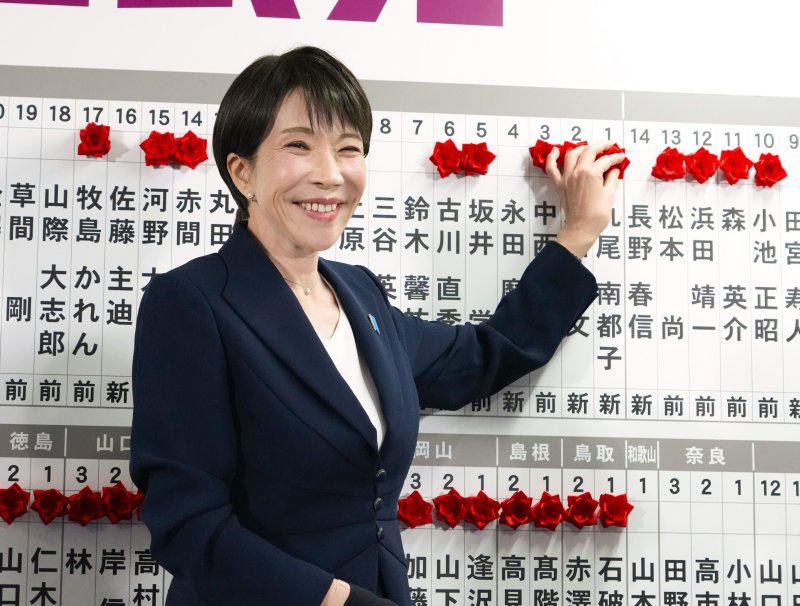
| Japanese Prime Minister Sanae Takaichi beamed with joy on February 8 as she celebrated her party’s landslide victory in the House of Representatives election, adorning successful candidates’ names with flowers. Photo = Newsis |
【Financial News, Tokyo Bureau = Special Correspondent Seo Hye-jin】The ruling Liberal Democratic Party (LDP), led by Prime Minister Sanae Takaichi, secured a decisive win in the February 8 House of Representatives election, catalyzing momentum for constitutional reform discussions. The LDP is poised to reclaim the chairmanship of the Constitutional Review Committee, a move that would allow them to steer the amendment process. Opposition parties, reeling from their electoral defeat, are wary of the LDP leveraging its numerical advantage to push through constitutional changes.
■Prime Minister and Defense Minister Advocate for Swift Constitutional Referendum
According to reports from the Nikkei and other sources, members of Takaichi’s cabinet have been vocal about expediting a national referendum on constitutional amendments since the election.
Defense Minister Shinjiro Koizumi emphasized at a February 10 press conference the urgency of providing citizens with an opportunity to vote on the proposed amendments, stressing the need to swiftly establish the necessary framework for a referendum.
Koizumi underscored the importance of allowing both proponents and opponents of the amendments to voice their opinions. He argued that once the procedural groundwork is laid, the government must act decisively toward implementation. However, he refrained from detailing specific amendment proposals, such as explicitly mentioning the Self-Defense Forces (SDF) in the constitution.
The LDP has consistently advocated for constitutionally recognizing the SDF and included this pledge in its election platform.
A day earlier, in her first post-election press conference, Prime Minister Takaichi reaffirmed her commitment to pursuing constitutional amendments, declaring, “We will continue our efforts to revise the constitution.”
She expressed her determination to foster an environment conducive to holding a national referendum on the amendments, pledging to seek cooperation across party lines based on previous discussions and established points of consensus.
During her campaign, Takaichi questioned the absence of the SDF in the constitution, arguing that amending the document is crucial for upholding the force’s dignity and ensuring its development into a robust organization. The LDP plans to seek support from various parliamentary groups for constitutional reform.
The process for amending Japan’s constitution requires each party to submit draft proposals to the Diet for review by the Constitutional Review Committees in both houses. If two-thirds of members in both chambers approve, the proposal advances to a national referendum. This referendum must occur within 60 to 180 days, with a simple majority required for ratification.
■LDP Prioritizes Regaining Control of Constitutional Review Committee
The Takaichi administration and the LDP are expected to focus on reclaiming the chairmanship of the Constitutional Review Committee as a crucial step toward facilitating a national referendum.
The Constitutional Review Committee, a permanent body in both Diet houses, is tasked with examining amendment proposals, discussing referendum laws, and overseeing constitutional interpretation and application. It serves as the primary platform for initiating constitutional reforms.
The committee chair wields significant influence, controlling meeting schedules, agenda-setting, deliberation pacing, and inter-party negotiations. This role’s operational authority can substantially impact the trajectory of constitutional discussions, with the potential to either advance or stall reform efforts depending on who holds the position.
Traditionally, the chair is determined through inter-party negotiations, typically going to the majority party or coalition.
Following the LDP’s significant setback in the 2024 House of Representatives election, Yukio Edano of the Constitutional Democratic Party assumed the committee chair. He prioritized discussions on clarifying extraordinary Diet session convocation deadlines and limiting cabinet powers to dissolve the lower house.
The LDP’s key priorities, such as constitutionally recognizing the SDF and introducing emergency powers provisions, were initially sidelined.
Takaichi expressed frustration with opposition-led constitutional discussions during her campaign. While stumping in Joetsu City, Niigata Prefecture, she lamented, “It’s regrettable that the opposition holds the Constitutional Review Committee chair,” signaling the ruling party’s intent to reclaim the position through increased parliamentary representation.
With the LDP securing 316 seats, surpassing the two-thirds threshold (310 seats) in the House of Representatives, the prospects for independently proposing amendments and reclaiming the committee chairmanship have significantly improved.
■Can Takaichi Succeed Where Abe Failed?
However, the opposition’s continued majority in the House of Councillors presents a significant hurdle. Currently, the LDP and its ally, the Japan Innovation Party, fall short of the two-thirds majority (165 seats) in the 247-seat upper house. Even with support from amendment-friendly parties like the Democratic Party for the People, the Constitutional Democratic Party, and the Japan Conservative Party, they only reach 162 seats. Securing backing from independents could potentially help them achieve the necessary two-thirds in both chambers.
Former Prime Minister Shinzo Abe also prioritized constitutional reform during his tenure. The 2016 House of Councillors election saw pro-amendment forces surpass two-thirds in both houses. Consequently, Abe proposed enshrining the SDF in 2017, aiming to implement a new constitution by 2020 and igniting reform discussions.
The LDP unveiled its amendment proposals at its March 2018 party convention, including constitutionally recognizing the SDF, emergency response measures, electoral district integration, enhancing local autonomy, and improving education.
However, cross-party discussions failed to gain traction. The opposition boycotted the Constitutional Review Committee amid scandals involving Abe, such as the Moritomo and Kake Gakuen controversies. Even the LDP’s coalition partner, Komeito, maintained a cautious stance, insisting on preserving Article 9’s “defensive defense” principle. Ultimately, reform momentum dissipated.
The Nikkei reported, “Numerous obstacles to constitutional amendments persist. The lack of clarity on priority issues is problematic,” adding that some within Takaichi’s administration speculate that amendment proposals might not materialize until after the 2027 House of Councillors election.
■Japan Innovation Party Takes Harder Line Than LDP
The opposition could pose significant challenges to Takaichi’s constitutional reform agenda. In the wake of their electoral defeat, opposition parties are increasingly wary of what they perceive as Takaichi’s consolidation of power. Yoshihiko Noda, co-leader of the Center-Left Reform Coalition, emphasized at a February 9 press conference, “As the ruling party has grown too dominant, our role in presenting alternative perspectives has become even more crucial.”
The Japan Innovation Party, the LDP’s coalition partner, is particularly alarming to the opposition. The Innovation Party advocates for deleting Article 9’s second clause, which prohibits maintaining military forces, and fully permitting collective self-defense exercises. This stance is even more hawkish than the LDP’s position.
Establishing an appropriate framework for the national referendum also presents challenges. Current law restricts TV and radio advertisements regarding constitutional amendments in the two weeks preceding the vote. However, the proliferation of internet advertising has called this regulatory approach into question.
sjmary@fnnews.com Seo Hye-jin, Reporter









Most Commented