
Translation result.
War Is Further Eroding Humanity’s Public Good: the Climate
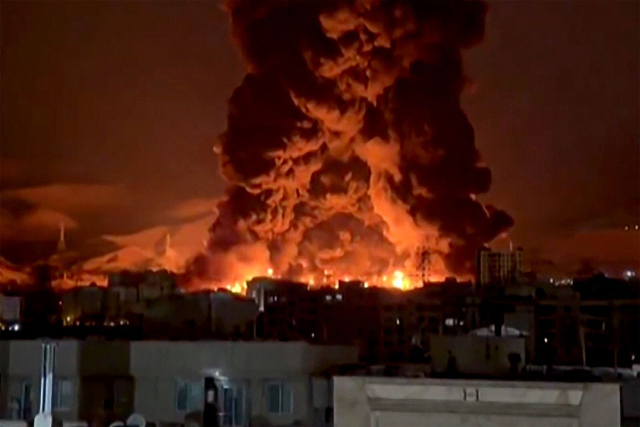
The 2026 Iran war, which began with unannounced strikes by the U.S. and Israel on the 28th of last month, has passed the ten-day mark. The conflict has killed more than 1,000 people in Iran alone, and the U.S. is spending $1 billion a day — roughly 1.5 trillion KRW (about $1.125 billion) — on the fighting. War is inherently inhumane and catastrophic, and it also inflicts serious harm on the climate.
The military’s carbon footprint is notorious. A single fighter jet can burn in an hour about as much fuel as a typical passenger car uses in years, and every major weapons system — from aircraft carriers to tanks — is a voracious consumer of fossil fuels. Bombing kills forests and habitats, contaminates soil, and releases carbon and methane during destruction; every act of war worsens the climate. By reversing U.S. emissions trends last year and mobilizing the U.S. military — one of the world’s largest institutional greenhouse-gas emitters — President Trump is driving global emissions higher through renewed conflict.
At this decisive moment, as the planet edges toward a 1.5°C rise (about 2.7°F), the world is grappling with wars in Ukraine and Gaza and now Iran. That reality leaves us with two urgent tasks. The first is to urgently restore collapsing global governance for climate action. This echoes what Joseph Nye has described as the Kindleberger trap. Nearly a century ago, economic historian Charles Kindleberger argued that the Great Depression was aggravated by the absence of any nation willing to supply global public goods — stable trade relations, exchange-rate adjustments and liquidity support.
At that time, the established power, Britain, had lost the capacity to stabilize the world economy, while the rising power, the United States, had the capacity but lacked the will. No one assumed responsibility, and Joseph Nye labeled that failure the Kindleberger trap. Today’s order looks disturbingly similar. The established power that should model adherence to global norms, the United States, has in some cases led in undermining them. The rising power, China, continues to prioritize national security and economic stability over proactive leadership on war deterrence or international climate governance.
That stance matters especially for climate policy. A second Trump administration has dismantled decades of climate accords and institutional frameworks while reviving fossil-fuel development across the board. Meanwhile, China — which has supplied cheap renewable-energy technology globally — has set out a new 15th Five-Year Plan but shows few signs of tightening explicit greenhouse-gas reduction targets or stepping up in international climate governance.
In this environment, middle powers such as South Korea must play a critical role. Middle-power states should form coalitions to lead climate action, press major powers to honor global norms and rules, and encourage developing-country participation. The goal must be to prevent the climate response, already weakened by war, from being completely neutralized and to minimize disaster losses from global warming.
Iran Invasion Reaffirms “Energy Security.” This Time, Respond Differently.
The Iran war’s ripple effects also create new domestic challenges for climate policy. The conflict has severely disrupted oil and gas supplies from the Middle East. South Korea currently depends on the region for about 70% of its oil and 20% of its gas, so the war’s impact on energy supplies is substantial. That dependence helps explain why the stock market here has swung more wildly than in many other countries and why pump prices have surged. If the fallout expands, both the macroeconomy and household livelihoods will suffer significant damage.
Renewables — solar and wind in particular — have again proven crucial not only for climate mitigation but also for energy security. A large-scale shift to clean power that reduces dependence on imported oil can be decisive during conflicts. The European Union’s REPowerEU plan, which accelerated the renewables transition after the 2022 Ukraine invasion, followed that logic.
We should use this supply shock as a reason to accelerate decarbonization and the renewables transition. President Lee Jae-myung has urged that “we should use this moment to cut fossil-fuel use and rapidly, ambitiously accelerate the shift to renewable energy.” In that spirit, governments should avoid repeating familiar short-term fixes such as repeated fuel-tax cuts or hard price caps on gasoline. Those measures simply cushion fossil-fuel costs and perpetuate consumption; when the next crisis hits, the same cycle repeats.
Instead, policymakers should seize the moment to shift everyday life so households and commuters use less fossil fuel. For example, the government could quickly subsidize rooftop solar installation costs for apartment complexes to lower residents’ shared utility bills, or temporarily offset part of the cost of balcony solar systems to reduce household electric bills.
The same principle applies to transportation. Short-term measures such as fuel-tax cuts leave people locked into private-car use. Since the 2022 Ukraine war, Korea has extended fuel-tax reductions roughly twenty times; estimates place the total cost at nearly 20 trillion KRW (about $15 billion). This time, policy should both reduce costs and change behavior — for example, temporarily increasing K-Pass refund amounts to encourage public transit use over private cars.
When fuel prices spiked after the Ukraine war, Germany introduced its well-known €9 (about $9.63) ticket for a limited period — a useful precedent. The aim should be to blunt the price shock caused by war-driven fuel spikes while steering toward climate-positive solutions.
War is pushing an already perilous climate into a corner. Global climate governance is badly entangled, and nations now face overlapping risks from climate disasters and energy shocks. Finding the wisdom to turn this worst of disasters — war — into momentum for a cleaner, more secure energy transition is imperative.









Most Commented