
Translation result.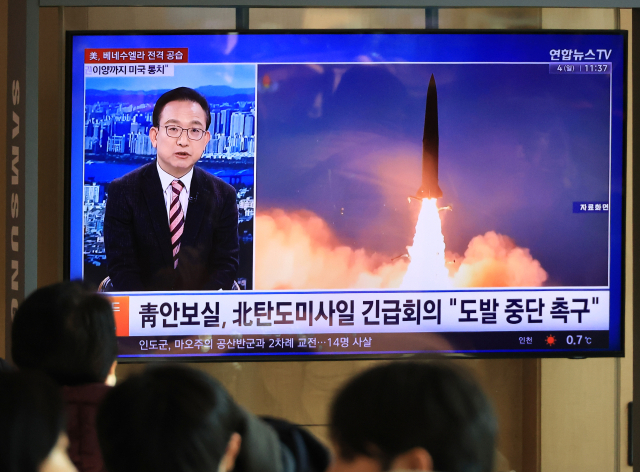
South Korea launched an emergency security review after North Korea fired roughly 10 ballistic missiles into the East Sea.
On March 14, the National Security Office convened an emergency meeting with the Defense Ministry, the Joint Chiefs of Staff and other agencies to assess the launches’ impact on national security and to review response options.
The office called the launches provocations that violate U.N. Security Council resolutions and urged Pyongyang to stop immediately.
It ordered agencies to maintain heightened readiness while the South Korea–U.S. joint exercise Freedom Shield (FS) is under way, and it briefed President Lee Jae-myung on the situation and response measures.
According to the Joint Chiefs of Staff, North Korea launched about 10 unidentified ballistic missiles from the Sunan area of Pyongyang toward the East Sea at approximately 1:20 p.m. The projectiles flew roughly 350 km (about 217 miles). South Korean and U.S. authorities are conducting detailed analyses of the missiles’ specifications.
It was Pyongyang’s first ballistic missile launch in 47 days — since Jan. 27 — and its third so far this year. Analysts say launching around 10 missiles in a single salvo is highly unusual and appears intended as a show of force.
The launch also seems aimed at responding to the ongoing Freedom Shield exercises, which began March 9. Observers say the timing suggests an effort to raise military pressure during the drills.
The strike came shortly after U.S. President Donald Trump signaled willingness to resume talks with Kim Jong Un, renewing attention on prospects for U.S.-North Korea diplomacy. Trump reportedly said he maintains a good relationship with Kim and questioned whether the North Korean leader wants talks with the United States or with him personally.
South Korean Prime Minister Kim Min-seok, who was visiting the United States, said after a roughly 20-minute Oval Office meeting with Trump on March 13 that the president showed strong interest in meeting Kim Jong Un. Trump has repeatedly offered to meet Kim since taking office, and a planned trip to China later this month had raised the possibility of talks.
But analysts say North Korea’s missile barrage the same day undercut momentum for dialogue.
Experts also note that a complex international environment — including rising tensions between the United States and Iran — gives Pyongyang limited incentive to pursue immediate talks with Washington.
U.S. officials are unlikely to accept Pyongyang’s demand for recognition as a nuclear-weapon state as a precondition for negotiations, particularly amid escalating Middle East tensions over Iran’s nuclear program.





Most Commented