
Why ‘난축맛돈’ is Revolutionizing Korean Pork: A Deep Dive into Quality and Profitability
Daniel Kim Views
Translation result

Meet Nanchuk Matdon, a homegrown black-pig breed that preserves the signature meat quality of Jeju’s native black pigs while boosting productivity. It’s catching on fast with farmers and consumers and helping expand Korea’s domestic black-pig market.
On March 18, the Rural Development Administration announced plans to build an industry-wide system linking production, distribution, and consumption around Nanchuk Matdon to grow the domestic black-pig market. The name literally means a tasty pig (don) created by the Nanjichuk Livestock Research Center. Developed in 2013, the breed keeps Jeju black pigs’ meat traits and black-hair genes while crossing with more productive lines.
Production has scaled up quickly. In 2019, just one farm in Jeju raised the breed. By 2025, that number had grown to 14 farms nationwide (12 in Jeju and 2 on the mainland). Last year, 113 breeding animals were supplied to a farm in Sancheong, Gyeongnam, marking the breed’s spread beyond Jeju. Restaurants offering the pork rose from two in 2019 to 68 across the country as of February this year, including three spots in Daegu (Jung-gu, Seo-gu, and Gunwi) and two in North Gyeongsang (Pohang and Sangju). Online sales channels like Naver Smart Store and Market Kurly have also expanded.
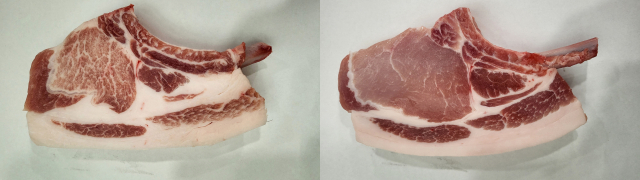
What really sets Nanchuk Matdon apart is its marbling. Even on the same feed, its intramuscular fat averages over 10%—up to four times higher than ordinary pigs (1–3%). Its meat redness averages 12.35, much clearer than ordinary pigs (6.5–8.5).
Jo Yong-min, director of the National Institute of Animal Science at the Rural Development Administration, says the breed was improved so marbling appears evenly even in foreleg and hind-leg cuts that were once unpopular. That means lower-fat cuts like loin and hind leg, which used to be tough sells for grilling, can now be enjoyed on the grill.
That shift is already showing up in restaurants. Trendy dishes blending different cuts—like the “donmahawk,” which brings together gabrisal, loin, and pork belly—have started to appear on menus.
On health concerns around marbling, Jo notes scientific evidence shows pork fat has a lower share of saturated fatty acids and includes many flavor-enhancing components, so it isn’t necessarily unhealthy. He emphasizes that Nanchuk Matdon’s benefit is this fat isn’t concentrated only in popular cuts like pork belly or neck; it’s evenly distributed across loin, foreleg, and hind leg.
He adds that spreading desirable fat across more cuts can reduce the skewed demand that piles up on a few parts and, at the same time, boost farmers’ profitability.
The economics are convincing. At the same slaughter scale (2,500 head), the carcass price averages 8,500 KRW per kg (approximately $6.38)—higher than ordinary pigs at 6,630 KRW per kg (approximately $4.97) and Jeju black pigs at 7,340 KRW per kg (approximately $5.51). Analysts estimate this translates to roughly 230 million KRW (approximately $172,500) in additional annual revenue compared with Jeju black pigs.
Industry development is centered on the Nanchuk Matdon Research Association, founded in 2020 and made up of producers, distributors, universities, and research institutes. Members share feeding, breeding, and shipment standards and run a quality-control system that ties slaughtering, processing, and distribution together to deliver consistent products to consumers.
The Rural Development Administration plans further genetic improvements: raising average litter size from about 10 piglets to 13 and shortening average slaughter age from 190 days to 185 days. It will use piglet genetic testing to strengthen breed credibility and gradually expand dedicated farms and distribution networks.
Jo says Nanchuk Matdon offers a new model that moves beyond merely preserving native livestock resources and instead brings them into industry and market use. The goal is to expand the industrial base so farmers gain new income opportunities and consumers can confidently choose a premium domestic pork.






Most Commented