Quick access to main page (top) Direct access to main contents Quick access to main page (bottom)

What Does the ‘Yellow Envelope Law’ Mean for Labor Negotiations in South Korea?

Daniel Kim Views  

Translation result

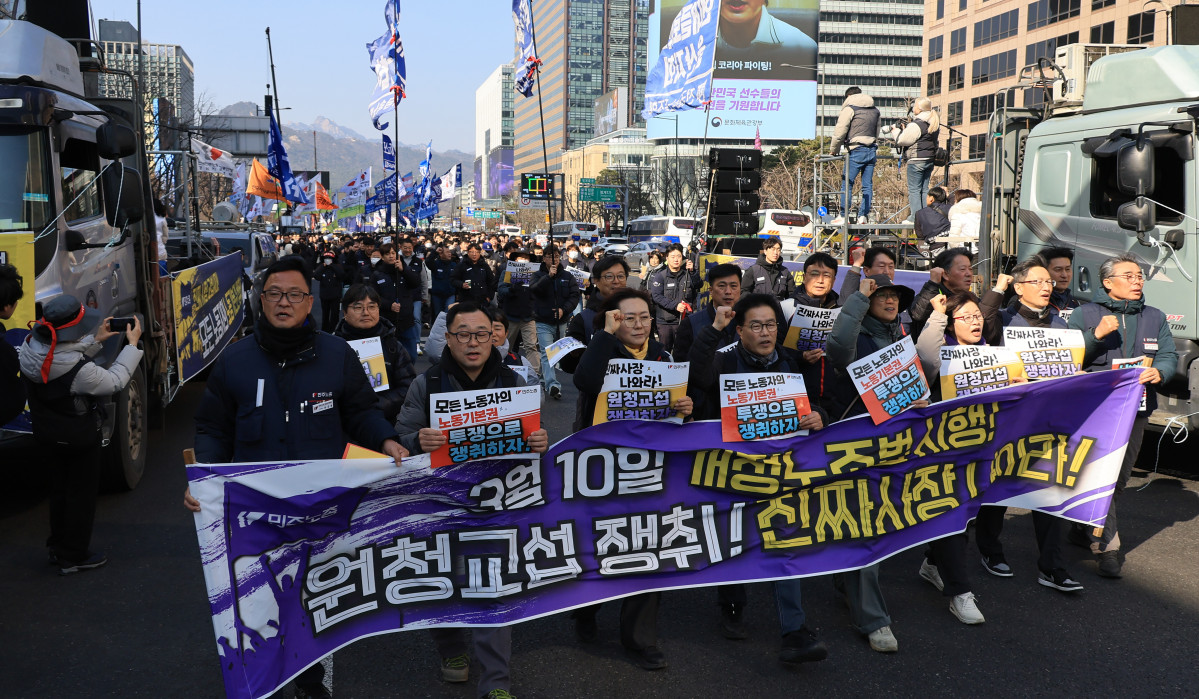
   Yonhap News AgencyOn the first day of enforcement of the Yellow Envelope Law (amendments to Articles 2 and 3 of the Trade Union and Labor Relations Adjustment Act) last month, on the 10th, members of the Korean Confederation of Trade Unions march after a rally in Sejong-ro, Seoul.
  Yonhap News AgencyOn the first day of enforcement of the Yellow Envelope Law (amendments to Articles 2 and 3 of the Trade Union and Labor Relations Adjustment Act) last month, on the 10th, members of the Korean Confederation of Trade Unions march after a rally in Sejong-ro, Seoul.

Following earlier rulings in the public sector, the Labor Relations Commission has issued its first decision recognizing a prime contractor as the employer in the private sector.

On the 7th, Yonhap reported that the Seoul Regional Labor Relations Commission held hearings on correction requests that sought public notices of bargaining demands filed against the Induk Foundation (Induk University) and Sungkonghoe University. The commission granted both requests.

This is the first time a public notice of bargaining demands has been accepted in the private sector; previously the commission had granted all five related correction requests in the public sector.

Since the law took effect, subcontractor unions at Induk University and Sungkonghoe University have sought negotiations with their respective schools, listing workplace safety, working conditions, benefits, wages, and hours on their agenda.

Under the Yellow Envelope Law, when a subcontractor union requests bargaining, the principal employer must publicly post notice of that demand for seven days beginning the day it receives the request. Both universities denied employer responsibility and declined to post the notice, prompting the subcontractor unions to file correction requests with the Seoul Regional Labor Relations Commission.

The commission’s ruling requires the institutions to post the bargaining-demand notices for seven days. If a principal employer objects, it may petition the Central Labor Relations Commission for a rehearing; if it still contests the outcome, the employer must pursue administrative litigation.

Labor authorities may sanction employers for unfair labor practices if they intentionally or maliciously refuse to bargain during this process.

Meanwhile, the Seoul commission also granted a correction request from the union of a Korea Airports Corporation subsidiary seeking a public notice of its bargaining demand.

Most Commented

Daniel Kim
content@en.tenbizt.com

[Social] Latest Stories

  • Starbucks Korea CEO Fired Over Controversial ‘Tank Day’ Promotion
    Starbucks Korea CEO Fired Over Controversial 'Tank Day' Promotion
  • 25,000 Robots vs. Human Workers: The High-Stakes Battle at Hyundai
    25,000 Robots vs. Human Workers: The High-Stakes Battle at Hyundai
  • Hotel Hygiene Scandal: Cleaner Caught Using Guest Towels to Wipe Toilets
    Hotel Hygiene Scandal: Cleaner Caught Using Guest Towels to Wipe Toilets
  • South Korea’s Tech Giant Kakao Faces First Major Strike in 20 Years
    South Korea's Tech Giant Kakao Faces First Major Strike in 20 Years
  • South Korea’s Aging Crisis: How One Leader Is Redefining ‘Well-Dying’
    South Korea’s Aging Crisis: How One Leader Is Redefining 'Well-Dying'
  • Stop Calling Them ‘Hey You’: South Korea’s New Push for Worker Respect
    Stop Calling Them 'Hey You': South Korea's New Push for Worker Respect

Weekly Best Articles

  • 2026 FIFA World Cup in LA: 39 Days of Unforgettable Fan Experiences and Events!
  • Maximize Your Paris Trip: Essential Guide to Mont Saint-Michel Day Tours and Overnight Stays
  • Dubai vs. Japan: Which Destination Offers Better Safety and Cleanliness for Travelers?
  • ASEAN Tourism Forum 2026: Key Insights on Sustainable Growth in Cebu
  • Hyeri’s Luxurious Tokyo Baby Moon: Discover Why Bulgari Hotel Stands Out
  • Mont Saint-Michel Tour: Day Trip vs. 1-Night Stay – Which One Suits Your Travel Style?

Weekly Best Articles

  • 2026 FIFA World Cup in LA: 39 Days of Unforgettable Fan Experiences and Events!
  • Maximize Your Paris Trip: Essential Guide to Mont Saint-Michel Day Tours and Overnight Stays
  • Dubai vs. Japan: Which Destination Offers Better Safety and Cleanliness for Travelers?
  • ASEAN Tourism Forum 2026: Key Insights on Sustainable Growth in Cebu
  • Hyeri’s Luxurious Tokyo Baby Moon: Discover Why Bulgari Hotel Stands Out
  • Mont Saint-Michel Tour: Day Trip vs. 1-Night Stay – Which One Suits Your Travel Style?

Hot Topics

Share it on...