
How America’s Military Stockpile Depletion Could Affect Asia: Insights and Implications
Daniel Kim Views
Translation result.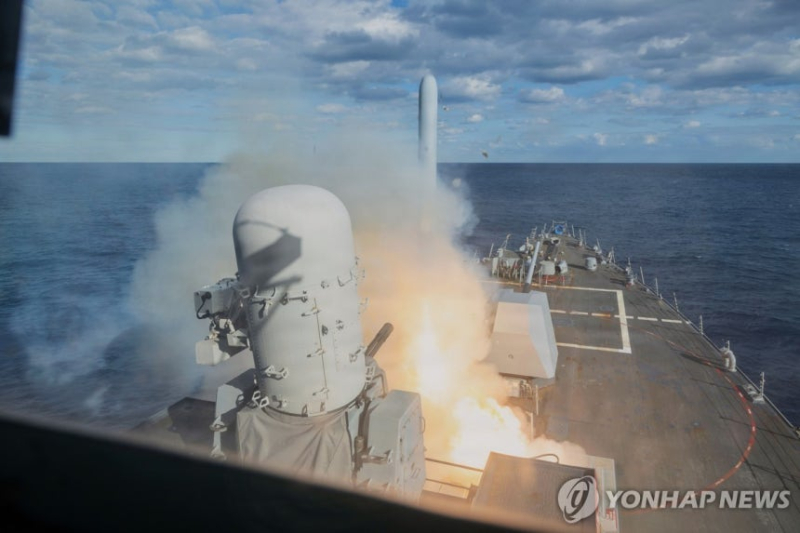
As the United States has expended large quantities of key capabilities—most notably precision-guided munitions—in the war with Iran, U.S. officials and analysts warn that its capacity to respond to potential future clashes with China or Russia could be weakened.
On April 23, The Wall Street Journal, citing U.S. officials, reported that American forces fired more than 1,000 Tomahawk cruise missiles and roughly 1,500–2,000 air-defense interceptors, including those from THAAD and Patriot batteries, during the Iran campaign. Officials estimate it could take up to six years to rebuild those stocks.
The New York Times similarly reported that roughly 1,100 long-range cruise missiles and about 1,200 Patriot interceptors—held in reserve for a possible conflict with China—have already been expended, sharply reducing U.S. weapons stockpiles. Each Patriot interceptor costs more than $4 million, and analysts put the overall cost of the campaign at about $28 billion to $35 billion, roughly $1 billion per day.
U.S. forces have also been repositioned. A carrier strike group was redeployed from the South China Sea to the Middle East, and a Marine expeditionary unit based in Japan was dispatched to the region. Some THAAD interceptors stationed in South Korea have reportedly been moved to the Middle East as well. U.S. Forces Korea commander Javier Brunson told the U.S. Senate recently, “The THAAD system remains in place, but some munitions are in transit.”
The drawdown has implications for U.S. forces throughout Asia. The Pentagon is reportedly reviewing possible adjustments to existing operational plans for a Taiwan contingency. The Center for Strategic and International Studies (CSIS) warned that the large missile expenditures in this campaign could increase the military burden across the Western Pacific.
Restocking weapons will take time, and production capacity is a critical factor. Major defense contractors such as Lockheed Martin and Raytheon Technologies are ramping up output, but constraints on key components and skilled labor make it difficult to boost production quickly.
Accordingly, the Pentagon is exploring measures to accelerate recovery, including cooperative production with allies and diversifying supply chains.
China’s military buildup adds another variable. The Pentagon estimates China now possesses more than 600 nuclear warheads and continues to strengthen its missile and naval forces. Experts warn that a sustained decline in missile stockpiles could turn into a long-term strategic risk.
Still, senior U.S. officials maintain that the current rate of weapons expenditure has only a limited effect on near-term readiness.









Most Commented