
Is ‘난축맛돈’ the Future of Korean Pork? Explore Its Unique Benefits and Growing Popularity
Daniel Kim Views
Translation result
RDA industrializes Jeju native black pig breed, expanding farms from 1 to 14
Restaurants carrying the breed jump from 2 to 68 — analyzed extra annual revenue of 232,000,000 KRW (about $174,000) over Jeju black pigs

The market for black pork is shifting beyond its long-held focus on pork belly and neck. A domestic black-pig breed that makes leaner cuts like loin and hind leg grill-ready has begun to gain traction, and that’s starting to change a market that once relied heavily on imported breeding stock. The RDA’s new breed, Nanchuk Matdon, preserves beloved flavor while boosting productivity — and it’s now spreading from Jeju to the mainland as a pilot for growing Korea’s domestic black-pig market.
The Rural Development Administration (RDA) held a briefing at the Government Sejong Complex on the 18th to announce the industrialization results and expansion plan for Nanchuk Matdon, a black-pig breed developed from Jeju’s native genetic resources.
Nanchuk Matdon keeps the meat-quality traits and the black-hair gene of Jeju’s native black pig while improving industrial productivity. Researchers identified genes tied to flavor and coat color, then crossed those animals with higher-performing lines. Through genetic analysis, on-farm trials and additional selective breeding, the RDA selected individuals that combine desirable taste with better productivity to build an industrial production base.
Production capacity is scaling quickly. Nanchuk Matdon farms grew from one in 2019 to 14 this year — 12 on Jeju and two on the mainland. Last year the RDA sent 113 breeding hogs to a farm in Sancheong, South Gyeongsang Province, to kick off expansion beyond Jeju.
Demand channels have broadened, too. Restaurants serving Nanchuk Matdon climbed from two in 2019 to 68 as of February. Distribution runs through Jeju Dream Pork, and producers are also selling online via Naver Smart Store and Market Kurly. A Nanchuk Matdon research group — made up of farmers, distributors, universities and research institutes — now operates a system linking production, distribution and consumption.
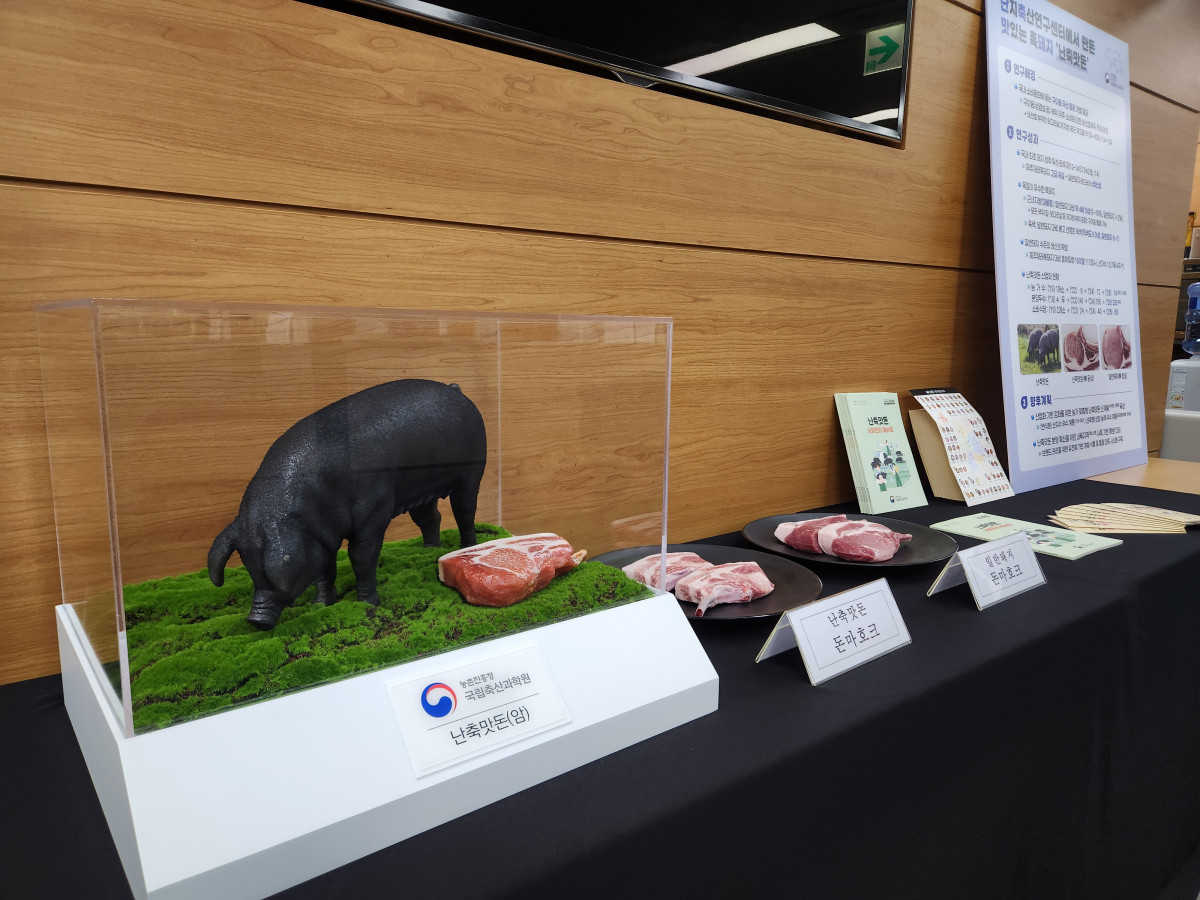
What really sets Nanchuk Matdon apart is that previously lean cuts are now sellable. The loin’s intramuscular fat averaged 10.5%, far above the typical 1–3% in ordinary pigs, and the meat scored higher on redness as well. That means cuts that were once less ideal for grilling — like loin, hind leg and shoulder — can now work beautifully for barbecue, the RDA says. Being able to market the whole carcass for grilling gives restaurants more menu flexibility and strengthens distribution strategies.
The RDA also confirmed improved profitability. Using last year’s baseline — an 80 kg carcass weight and 2,500 heads shipped — the average carcass price for Nanchuk Matdon was 8,500 KRW per kg (about $6.38/kg or $2.89/lb), compared with 7,340 KRW per kg (about $5.51/kg or $2.50/lb) for Jeju black pigs and 6,630 KRW per kg (about $4.97/kg or $2.26/lb) for ordinary pigs. Based on those figures, annual revenue is estimated to be 232,000,000 KRW (about $174,000) higher than for Jeju black pigs and 374,000,000 KRW (about $280,500) higher than for ordinary pigs.
Farm performance has been steady. Across four Nanchuk Matdon farms, average litter size was nine to ten piglets, weaning counts eight to nine, carcass weight averaged 80.8 kg, and backfat thickness measured 20.4 mm. According to the Livestock Products Quality Evaluation Service’s 2023 data, Nanchuk Matdon’s rate of Grade 1 or higher was 44.1%, beating Jeju black pigs’ average of 27.4%.
To scale up further, the RDA plans to boost productivity and uniformity. Goals include raising average litter size from about 10 to 13 piglets and shortening days to market from 190 to 185. The agency will use genetic testing of piglets to confirm breed identity and strengthen feeding and management support to reduce quality variation across farms.
Cho Yong-min, director of the National Institute of Animal Science, said, “Nanchuk Matdon is a flagship research outcome that connects our native livestock resources to industrial production and consumer markets. We will keep expanding the industry base so farmers gain new income opportunities and consumers can choose reliable domestic black pork.”








Most Commented