
US Support for Japan’s Self-Defense Forces: What Does It Mean for Regional Security?
Daniel Kim Views
He stressed that strength is the only way to prevent U.S. entanglement in Indo-Pacific conflicts.
McMaster pointed to Russia’s invasion of Ukraine as a result of perceived weakness.
He also cited the Korean War, noting how North Korea and China miscalculated America’s resolve to defend its allies.
In the wake of Takaichi’s Liberal Democratic Party’s landslide victory in the recent House of Representatives election, securing 316 out of 465 seats, U.S. officials are discussing the Trump administration’s potential support for amending Japan’s pacifist constitution, particularly Article 9, which renounces war and military force.
During the February 9 panel in New York, McMaster, now a senior fellow at the Hoover Institution, stated, “The U.S. will back Japan’s efforts to bolster its Self-Defense Forces, and if Prime Minister Takaichi moves to amend the constitution beyond reinterpretation, we’ll likely support that initiative.”
He emphasized that this aligns with Trump’s “peace through strength” global security doctrine. Takaichi has consistently advocated for constitutional amendments to explicitly define the Self-Defense Forces’ role, especially in light of Japan’s post-World War II renunciation of war and military action.
Following the ruling party’s electoral triumph, Takaichi reaffirmed his commitment to constitutional reform.
McMaster emphasized, “Our top priority now is avoiding entanglement in major Indo-Pacific events. This can only be achieved through strength.”
He argued that potential adversaries like China must be convinced that military force won’t achieve their goals and that the costs and risks of aggression are too high.
Regarding Russia’s invasion of Ukraine, McMaster observed, “They saw a ‘weakness’ in Ukraine,” suggesting that recognizing such vulnerabilities often leads to aggression.
Daniel Russell, vice president of the Asia Society Policy Institute and former Assistant Secretary of State for East Asian and Pacific Affairs, joined the discussion, criticizing the term “strategic ambiguity” as inapplicable to military capabilities.
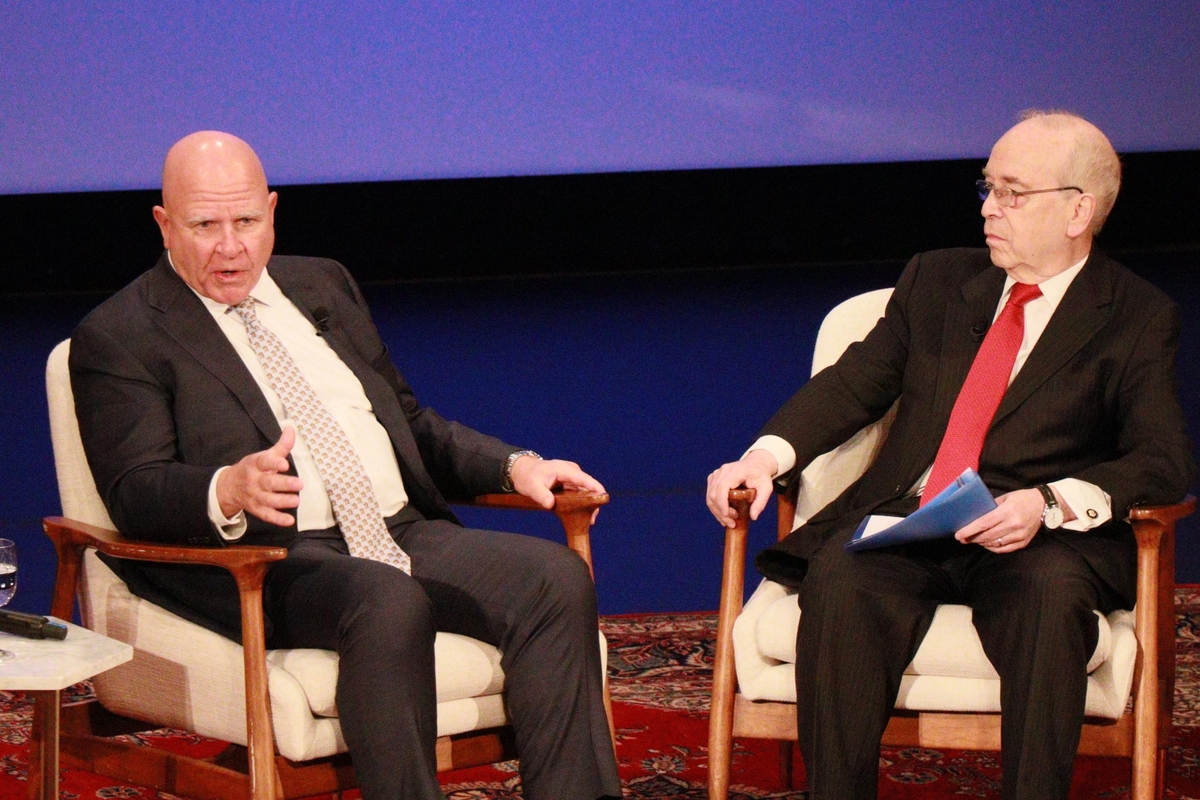
Russell asserted, “While final decisions on war or peace rest with military commanders based on the situation, there should be no ambiguity about U.S. commitments or capabilities.” McMaster concurred, referencing the Korean War in June 1950 as an example of how misjudgments about U.S. resolve to defend allies led to catastrophic consequences.
McMaster, a retired Army general, served as National Security Advisor during the early Trump administration when U.S.-North Korea tensions escalated over Pyongyang’s nuclear program. He stepped down after about 13 months due to disagreements with Trump over North Korea policy.









Most Commented