
Is Hanwha Group the Next Lockheed Martin? Exploring Their Aerospace Expansion Strategy
Daniel Kim Views
|
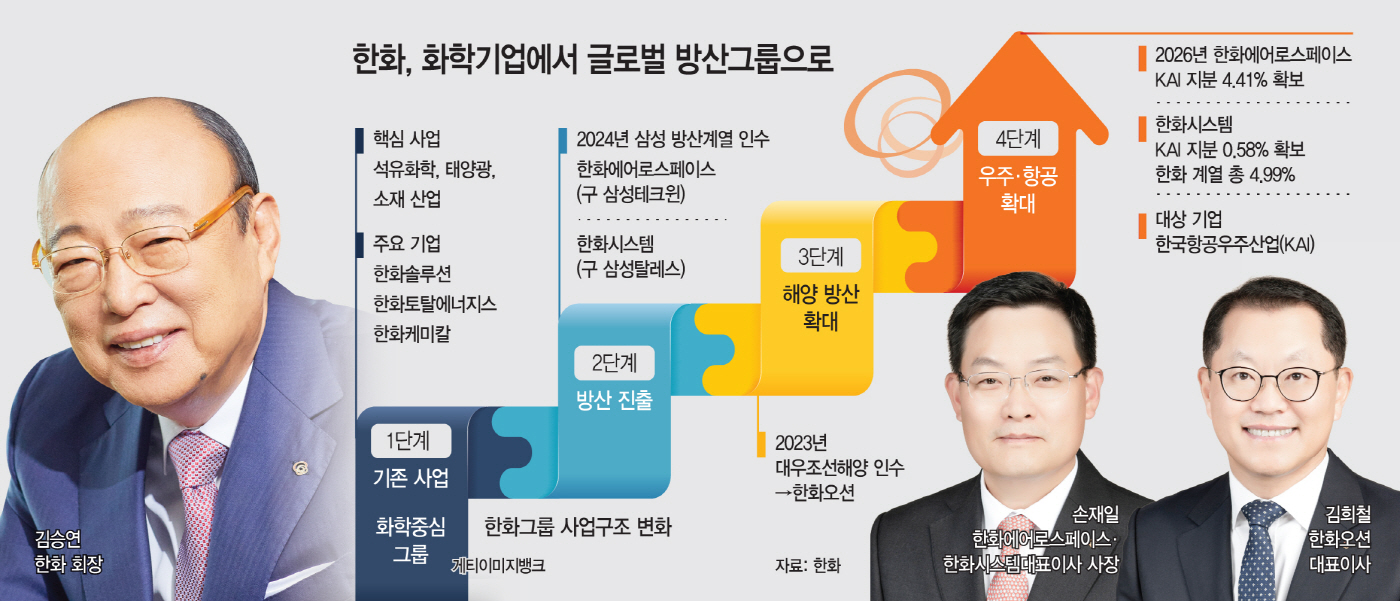
Chairman Kim Seung‑yeon’s vision for a “Korean Lockheed Martin” is taking shape. Hanwha Group has moved to deepen cooperation in aerospace after securing a stake in Korea Aerospace Industries (KAI). A dealmaker by trade, Kim first strengthened Hanwha’s naval defense capabilities by acquiring Daewoo Shipbuilding & Marine Engineering and is now expanding the group’s footprint into aerospace.
On March 17, filings with the Financial Supervisory Service’s electronic disclosure system show Hanwha Aerospace acquired a 4.41% stake in KAI late last year. Affiliate Hanwha Systems bought 0.58% (566,635 shares) in November for about 59.9 billion KRW (approximately $44.9 million). Together, Hanwha affiliates now hold 4.99% (4,864,000 shares) of KAI. This is the first time in roughly seven years that Hanwha affiliates have owned KAI shares since Hanwha Aerospace sold its entire 5.99% stake in 2018.
Industry sources say the purchases signal Hanwha’s serious push into aerospace. By adding aviation and space to its existing ground and maritime defense operations, the group is accelerating the build-out of an integrated defense portfolio that spans land, sea and air.
Hanwha has expanded its defense business around ground systems, aircraft engines and space technologies. After reorganizing Daewoo Shipbuilding into Hanwha Ocean, the group added maritime defense capabilities. Securing the KAI stake ties naval defense to aviation and space, a move analysts see as part of a strategy to become a global, full‑spectrum defense contractor.
Earlier this year, on Jan. 8, Chairman Kim visited Hanwha Systems’ Jeju Space Center in Seogwipo’s Haewondong. Wearing protective coveralls, he toured a satellite cleanroom and said, “Even when the road is hard, we must take it — that is Hanwha’s mission.” He added, “Satellites we build should monitor climate change, safeguard national security and contribute to a better life for humanity. That is the true meaning and value of our business.”
Hanwha says it will use the KAI stake to develop a more stable, long‑term partnership with the company. The two firms already cooperate on several defense projects, including the KF-21 fighter program. At the same time, they compete in some space segments, such as microsatellite systems.
Chairman Kim first outlined the “Korean Lockheed Martin” concept when he signaled a push into defense in November 2014, announcing plans to acquire Samsung Techwin. Hanwha later spent about 840 billion KRW (approximately $630 million) to acquire a 32.4% stake, becoming the largest shareholder and gaining joint control of Samsung Thales (now Hanwha Systems).
That acquisition helped Hanwha secure core defense technologies in aircraft engines, defense electronics and radar, broadening its defense foundation. In 2023, Hanwha completed its acquisition of Daewoo Shipbuilding, adding naval ships and submarines to its capabilities.
With the addition of the KAI stake, Hanwha’s defense portfolio now spans ground weapons, maritime power and aerospace.
A Hanwha Group official said the company’s moves — from the 2002 acquisition of Hanwha Life to purchases of four Samsung affiliates, the HSD Engine deal and the Daewoo Shipbuilding acquisition — reflect Chairman Kim Seung‑yeon’s consistent strategic direction. That, the official said, explains Kim’s January visit to the Jeju space center and Hanwha’s mid‑ to long‑term vision for space.
Analysts say the move will strengthen Hanwha’s competitiveness in the global defense market. KAI’s largest shareholder remains the Korea Eximbank (26.41%), with the National Pension Service holding 8.2% and Fidelity Asset Management at 7.67%. With this purchase, Hanwha becomes the fourth‑largest shareholder. If KAI were privatized, some observers say Hanwha could emerge as a leading acquisition candidate.
Many experts note that shifting global security dynamics are pushing military strategy beyond land, sea and air into space. By linking shipbuilding, ground weapons and aerospace, Hanwha has positioned itself to grow into a global, full‑spectrum defense firm.









Most Commented