
Translation result
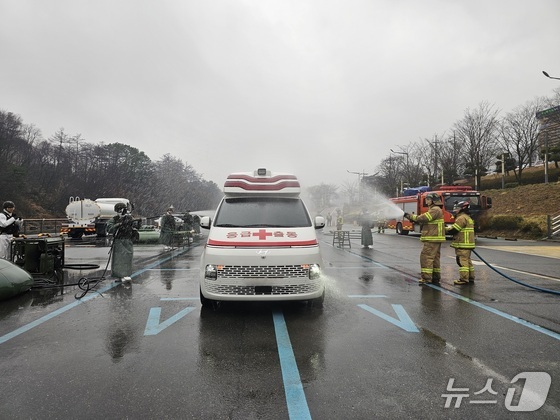
On March 18, the Army’s 32nd Infantry Division held an integrated exercise at Ppuri Park to strengthen post-incident response capabilities for nuclear and other weapons of mass destruction (WMD).
About 110 personnel from five organizations participated, including units under the division, the Jung‑gu District Office in Daejeon, the Western Fire Station, and the Jungbu Police Station. Conducted as part of the 2026 FS/TIGER exercise, the drill emphasized minimizing casualties from a nuclear or WMD attack and quickly stabilizing critical city functions.
The scenario simulated an enemy missile strike on Daejeon that delivered a tactical nuclear weapon. Daejeon’s Civil Defense Alert Control Center initiated the exercise by issuing emergency disaster text messages and broadcast alerts, directing residents to evacuate.
The Jung‑gu Office’s Integrated Defense Support Headquarters used an analysis system to model the spread of chemical, biological, and radiological contamination and assess damage. The division shared real-time response updates from each agency through a division-developed post-incident nuclear/WMD management program.
Assuming roads and buildings had collapsed from the strike, military and municipal teams deployed heavy equipment to clear routes and used drones and military vehicles for radiological reconnaissance. They prioritized securing transit corridors through water-spraying and decontamination operations.
At Ppuri Park, designated as the integrated decontamination site, officials established an on-site command post and an emergency medical station. Arriving personnel removed fallout with blowers, measured radiation levels, completed screening and triage, and proceeded to decontamination and medical treatment.
Contaminated individuals were re-triaged at the radiological emergency clinic: critical patients were transported to hospitals, while non-critical patients were decontaminated and moved to temporary facilities. Uncontaminated people received emergency care as needed or were allowed to return home.
The division said the exercise validated an urban integrated decontamination-site model that can address the limitations of outdoor decontamination sites. Officials also updated the facilities database and identified program improvements to better support local leaders’ decision-making.
Lt. Col. Jeon Young-hun, commander of the 2nd Battalion, Daesan Unit, said, “Effective nuclear and WMD response depends on rigorous post-incident management to minimize loss of life and control invisible contamination. We will continue to cooperate with partner agencies and do our utmost to protect the public’s lives and safety.”




Most Commented