
Translation result.
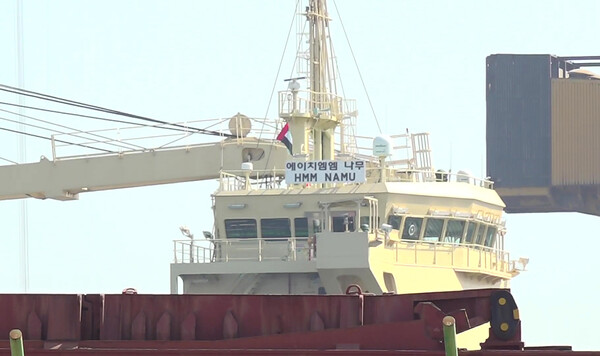
[The Public = Reporter Yang Won-mo] A preliminary government probe concluded that the explosion and fire aboard the South Korean-flagged HMM multipurpose carrier Namu, which occurred near the Strait of Hormuz, were caused when two unidentified aerial vehicles struck the ship’s stern in quick succession, roughly one minute apart.
The government’s joint investigation team released its findings on May 10, saying it confirmed that at about 3:30 p.m. local time on May 4 two aerial vehicles hit the Namu’s stern outer plating on two separate strikes. The team said the evidence points to external strikes as the likely cause rather than an internal fault.
Investigators found the impacts concentrated near the stern ballast tank. The port-side stern outer plating was damaged over roughly 5 meters and penetrated about 7 meters into the hull. The engine-room floor was breached, triggering an internal fire. A hemispherical penetration mark roughly 50 cm in diameter was observed at the damaged section.
Based on the damage pattern and its concentration around the stern ballast tank and engine room—about 1 to 1.5 meters above the waterline—the team judged a mine or torpedo strike unlikely. They also found no anomalies in major systems such as the engines, generators, or boilers that would indicate an internal explosion.
At the time of the incident, the Namu was operating in waters off Umm al-Quwain, UAE. After the blast the vessel lost propulsion and was towed to a Dubai repair yard. The investigation team conducted on-site inspections, reviewed CCTV footage, and interviewed the captain. Officials say they secured video showing an aerial vehicle approaching and striking the ship.
Crew members brought the fire under control after roughly four hours. The ship carried 24 people, including six Korean crew members. Authorities initially reported no fatalities, but later said one crew member sustained a small fracture to a cervical vertebra from the blast’s shock.
The government has not identified who carried out the attack. The Foreign Ministry said investigators face limits in confirming the launcher, exact model, or size of the aerial vehicles and will analyze recovered engine debris further. Experts say the impact locations and damage scale point more toward a drone attack than a cruise missile strike.
Meanwhile, on May 11 the Blue House strongly condemned the attack, saying assaults on civilian vessels are unjustifiable and unacceptable. The government has not confirmed any link to Iran. Officials plan to determine a response level after identifying the vehicle type and attacker through debris analysis and additional investigation.






Most Commented