
 By Yoon Ho, Herald Economy
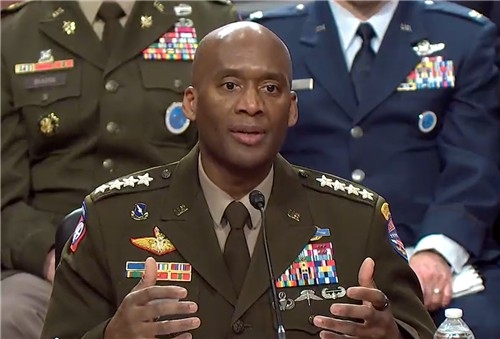
U.S. Forces Korea commander Javier Brunson publicly denied recent reports that the Terminal High Altitude Area Defense (THAAD) system had been removed from the Korean Peninsula.
Testifying before the U.S. Senate Armed Services Committee, Brunson was asked how redeploying THAAD assets to the Middle East would affect deterrence against North Korea. He replied, “We have not moved any THAAD systems. THAAD remains on the Korean Peninsula.” This is the first time a senior U.S. military official has publicly confirmed there was no THAAD withdrawal.
He added, “We are sending munitions, and they are staged for movement.” That comment suggested some components—such as interceptor missiles—rather than an entire THAAD battery, could be sent to the Middle East.
Explaining why the removal rumors spread, Brunson said equipment was moved around Osan Air Base to prepare munitions for transport. “That seems to have caused a misunderstanding in the intelligence community,” he said, adding it created “a kerfuffle” on the peninsula.
Brunson acknowledged that some assets have moved in the past but drew a clear distinction, saying those transfers were unrelated to the current controversy. He noted that last June, ahead of the U.S. airstrike operation “Midnight Hammer” against Iran, radars and other equipment were repositioned first, but the THAAD launchers themselves did not move.
On the planned transfer of wartime operational control, Brunson reiterated U.S. support for a conditions-based approach and warned that “political expediency must not get ahead of the conditions.”
“We must focus on the conditions,” he said. “That will make both the United States and South Korea safer.”
Brunson has repeatedly cautioned that meeting timelines should not come at the expense of required conditions. His use of the phrase “political expediency” marked a sharper public tone this time.
South Korean President Lee Jae-myung has said he intends to complete the wartime operational control transfer during his term. Some analysts expect U.S. and South Korean officials could present 2028 as a target year for the transfer at the 58th Security Consultative Meeting (SCM) in Washington, D.C., this October.
Brunson also reaffirmed his emphasis on capability over force size in South Korea.
“The Korean Peninsula is a critical strategic linchpin for defending the U.S. homeland and advancing American interests in the region,” he said. “U.S. Forces Korea are modernizing to meet rapidly evolving strategic challenges.”
“That is why I focus firmly on capabilities over numbers,” he added. “While presence remains a basic premise, we must focus on the specific capabilities that should be deployed on the peninsula to truly shift from quantity to quality.”
He said Korea-based units’ participation in Indo-Pacific Command exercises demonstrates the potential to project capabilities from Korea to support deterrence across the Indo-Pacific.
Brunson’s call to prioritize capability over numbers signals that, in a rapidly changing security environment, quality is outweighing quantity. Observers note that stance has implications for potential future reductions in U.S. troop levels in Korea.
His comments about participation in INDOPACOM exercises also suggest U.S. Forces Korea’s role — traditionally centered on deterring North Korea — may expand to help constrain China’s influence across the Indo-Pacific.



Most Commented