
Exploring the Timeless Charm of ‘방아타령’: Why This Traditional Korean Folk Song Still Resonates in 2026
Daniel Kim Views
Translation result
[News Culture reporter Lee Jun-seop] Bangga-taryeong is often presented as a jaunty, lively folk tune, but beneath its surface it concentrates the structure and aesthetics of Korean traditional music and a communal sensibility. It resists simple labels like work song or play song. Instead, it weaves together rhythms and life patterns accumulated over generations, and expressive forms refined through time still persist today. The song does more than sit before a listener—it operates as a cultural form that helps shape daily rhythms and shared feeling.
Scholars cannot pinpoint when Bangga-taryeong first emerged. Passed down orally long before it appeared in writing, the song layers the sensibilities and language of many eras. Transmitted in a memory-first environment, it evolved into music that naturally blends regional character with everyday life.
The name Bangga-taryeong comes more from its chorus than from any direct link to mortar-pounding work. The lyrics focus on nature’s flow and human feeling, unfolding lyrical images of dusk, moonrise and boats moving along waterways. Those scenes project the daily world and sensory life of the people of the time into the music.
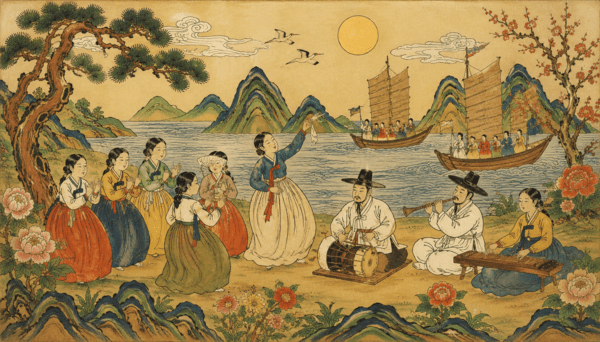
The lyrics don’t lock into a fixed form. Performers alter lines according to their choice and the moment, so the same tune can take on different colors each time it’s sung. That fluidity reveals that the music belongs to the community rather than to any single creator, and it provides the living basis that keeps the tradition alive.
The semachi jangdan rhythm forms the song’s structural core. Its flexible swing within a steady beat creates a natural breath that draws both players and listeners into the flow. Even within repeated patterns, shifts of tension and release keep the music vivid.
The recurring line Noja johguna (roughly, “How pleasant”) serves to bind the whole piece. It stabilizes the flow while keeping the rhythm, invites audience response and expands the musical space. Through that repetition, listeners develop an auditory rhythm and a shared communal breath at once.
The piece rarely ends on its own; performers often move into Jajeun Bangga-taryeong to shape the larger arc. As the tempo quickens and the register rises, the mood intensifies and the musical energy expands. That linked structure lets a performance function like a single narrative.
Performers adjust their approach to the setting. The song differs when sung naturally in daily life and when reconstructed onstage, but the human-to-human breathing that underpins it remains. In that way, Bangga-taryeong shifts form with context while preserving its core musical principles.
The song carries the sensibility of an era when music and everyday life were not separate. It begins and continues without elaborate staging, completing itself through participants’ responses. It’s a clear example of music that existed as part of life.
The way multiple voices blend is also central. Each singer maintains individual expression while finding harmony within the whole—a reflection of a community-centered musical culture.
Today, Bangga-taryeong is a staple of the gugak stage—gugak being Korea’s traditional music. Presented as a symbol of tradition, the piece has been expanded into new forms through varied arrangements and reinterpretations.
Even onstage, the song retains its essential energy. In the repeating chorus and steady rhythms, audiences and performers breathe together and the music springs back to life.
Its endurance owes much to a flexible capacity to adapt. Reconfigured in many forms, the song has broadened its meaning to suit new contexts.
In the end, Bangga-taryeong does not freeze into a relic. It continues to be remade in contemporary sensibilities and exists as living music that connects people.
News Culture Lee Jun-seop rhees@nc.press






Most Commented