
How the New US Investment Law Boosts South Korea’s Nuclear Submarine and Energy Cooperation
Daniel Kim Views
Translation result.
Analysts said on the 12th that the passage of the “Special Act for Strategic Investment Management toward the U.S.” (the Special Act on U.S. Investment) in the National Assembly could break the logjam that has stalled talks to revise U.S.-South Korea cooperation on nuclear-powered submarines and the U.S.-Korea nuclear cooperation agreement — negotiations Washington had slowed because of delays in Seoul’s investment plans.
Passage of the Special Act strengthens Korea’s negotiating leverage with the U.S. and revives momentum for talks on nuclear-submarine and nuclear cooperation.
The bill the National Assembly approved this afternoon would establish a Korea‑U.S. Strategic Investment Corporation to implement a Korea‑U.S. memorandum of understanding calling for roughly $350 billion in investment in the United States.
After the Trump administration released a joint fact sheet last October summarizing the leaders’ agreement, it pressed Korea to quickly develop and carry out an investment plan.
In January, President Trump warned he would raise reciprocal tariffs from 15% back to around 25%, saying the South Korean legislature had not ratified a historic trade deal.
Against that backdrop, lawmakers’ approval of the Special Act is likely to ease the “Trump risk.” U.S. officials have also reportedly expressed satisfaction with the National Assembly’s recent actions.
Tensions over the investment issue have directly affected U.S.-Korea consultations on Korea’s nuclear-submarine construction and on revising or adjusting the U.S.-Korea nuclear cooperation agreement. A U.S. negotiating team originally planned to visit Seoul in January, but the U.S. delayed, pushing that visit from February into March. Ultimately, Korea decided to send its delegation to the U.S. first to begin discussions on amending the nuclear cooperation agreement.
According to the Foreign Ministry, Lim Gap-soo, Seoul’s lead government representative for the U.S.-Korea nuclear cooperation task force, is currently visiting the U.S. and will remain in Washington, D.C., through the 12th (local time). Lim plans to meet officials from the State Department, the Department of Energy and the National Nuclear Security Administration.
Although most members of the government-wide task force on nuclear-powered submarines, led by the Defense Ministry, are not part of this U.S. visit, sources say that reflects Washington’s limited bandwidth while it responds to developments in the Middle East, rather than any lack of U.S. interest in the submarine talks.
On that note, a senior Foreign Ministry official told reporters that during a meeting today between First Vice Foreign Minister Jeong Hye and Assistant Secretary Michael G. DeSombre for East Asian and Pacific Affairs, both sides described the National Assembly’s passage of the Special Act as a positive development. The official added that the U.S. also agreed negotiations on nuclear-submarine construction and nuclear cooperation should not be delayed.
The timing of the Special Act’s passage and the uptick in senior-level U.S.-Korea communication suggest the two countries may now move more smoothly into talks on submarines and nuclear cooperation. Before DeSombre’s trip to Seoul, David R. Walz, the State Department’s deputy assistant secretary for East Asia and the Pacific, met Vice Minister Jeong for breakfast on the 10th in Seoul and held talks with the Foreign Ministry’s North America director, the director of Bilateral Economic Diplomacy, and the director of the Korean Peninsula Policy Bureau.
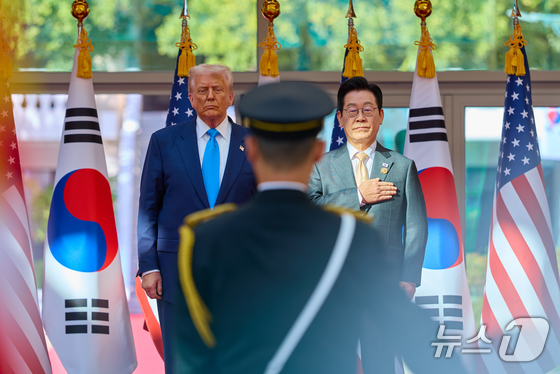
Concerns rise that the U.S. move to open a Section 301 investigation could introduce a new complication — but high-level U.S.-Korea communication continues.
Still, worries arose after the U.S. launched a Section 301 investigation, prompting questions about whether the probe could become another obstacle to submarine and nuclear cooperation talks.
The U.S. Trade Representative announced on the 11th (local time) that it would open investigations into 16 countries, including Korea, Japan and China, saying it expects to uncover unfair trade practices by major trading partners related to structural overcapacity in manufacturing. The statement signaled the probe could spark another round of trade friction.
Section 301 of the Trade Act, enacted in 1974, allows the U.S. to impose additional tariffs or restrict services if foreign governments take unfair actions against U.S. companies. After the U.S. Supreme Court last month found reciprocal tariffs imposed under the International Emergency Economic Powers Act (IEEPA) unlawful, U.S. officials had considered using Section 301 as an alternative.
The Korean government says it had anticipated this move to some degree and plans to respond calmly. A Blue House official said the government will consult to ensure the balance of benefits secured under the existing U.S.-Korea tariff agreement is preserved and that Korea does not receive treatment unfavorable compared with other major countries.
The government conveyed to the U.S. in meetings between Vice Minister Jeong and Assistant Secretary DeSombre that the U.S. probe should not undermine the existing trade agreement between the two countries. DeSombre reportedly said he understood that position.
Jaymeison Greer, a USTR representative, told a White House-led phone briefing today that most countries have expressed interest in maintaining and complying with existing agreements, suggesting those accords will remain separate from the Section 301 probe.
Experts largely view the USTR’s Section 301 move as a predictable step — “what had to happen” — and many say its impact on the already complex Korea‑U.S. talks on nuclear submarines and nuclear cooperation will likely be limited.
Park Won-gon, a professor at Ewha Womans University, said Korea should turn the situation into an opportunity by keeping negotiations focused on maintaining current tariff levels while pressing to begin the long-delayed submarine construction and nuclear-agreement revision talks. He added that Korea should highlight the passage of the Special Act, lay out concrete investment plans, and make sure it secures what it is due.







Most Commented