
500 Trillion Won Semiconductor Investment: Kim Young-rok’s Bold Promise for Gwangju
Daniel Kim Views
Translation result.
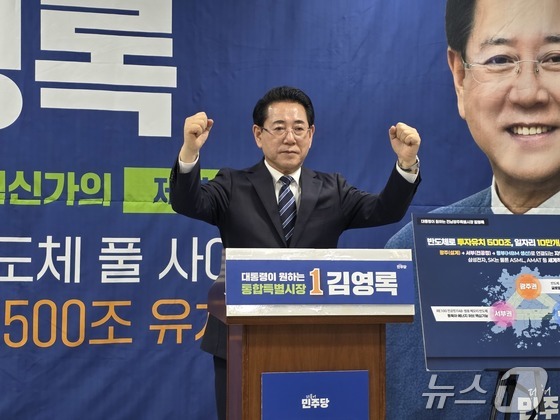
Kim Young-rok, governor of South Jeolla Province and a candidate in the Jeonnam–Gwangju integrated special mayoral race, unveiled a proposal to attract a semiconductor complex valued at 500 trillion KRW (375 billion USD).
On March 13, Kim briefed the Gwangju City Council, noting that companies such as Samsung Electronics and SK Hynix are pursuing investments on the order of 1,000 trillion KRW (750 billion USD) — the largest in the country’s history — and are staking their futures on the semiconductor sector. He argued that the Jeonnam–Gwangju region is well positioned for semiconductor production, offering ample power capacity, a stable water supply, and competitively priced industrial land.
He also said the area’s designation as a distributed-energy special zone has streamlined permitting and other administrative processes, prompting a surge in corporate inquiries. With OpenAI, SK and Samsung SDS already establishing data centers and a national AI computing center here, Kim urged that the region develop a semiconductor industry tailored to Jeonnam–Gwangju’s strengths.
Kim pledged to attract global semiconductor equipment leaders ASML and Applied Materials (AMAT), along with fabless design firms, to a development spanning 31,000,000 pyeong (about 39.6 square miles, roughly 25,320 acres).
Under a planned 500 trillion KRW (375 billion USD) private investment, Kim outlined a regional specialization: Gwangju as a hub for chip design and edge semiconductors; the western zone hosting RE100-powered, general-purpose memory front-end fabs; and eastern Jeonnam focused on mass production of high-bandwidth memory (HBM) and high-bandwidth flash (HBF).
He said the initiative could attract 500 trillion KRW (375 billion USD) in private investment and create roughly 100,000 jobs by 2035 if implemented.
On industrial electricity pricing — a key issue in the special mayoral contest — Kim previously cited the Ministry of Climate and Energy’s suggestion that rates could fall as low as 80 KRW per kWh (≈ $0.06/kWh). He later tempered that, saying an initial reduction to around 120 KRW per kWh (≈ $0.09/kWh) would already be a strong outcome.
For context, current industrial electricity rates run near 180 KRW per kWh (≈ $0.14/kWh). Lawmaker Shin Jeong-hoon has proposed about 90 KRW per kWh (≈ $0.07/kWh), while lawmaker Min Hyeong-bae has put forward figures in the 100 KRW range (≈ $0.08/kWh).
Addressing worries about personnel changes under administrative integration, Kim said the special law guarantees that no civil servant in the Jeonnam–Gwangju special city will be subject to unwanted transfers. He added that he understands the concerns of public employees, noting his experience running a department-choice application program as head of general affairs at the Ministry of Home Affairs in 2001.
On the prospect of staff exchanges between Gwangju and Jeonnam government offices, Kim said personnel rotations within existing districts should be sufficient and indicated there is no need to force inter-office transfers.
Regarding Rep. Lee Gae-ho, who withdrew on March 11 citing unfair primary rules, Kim said he was deeply saddened by the decision. He described Lee as a junior colleague with whom he has long worked side by side, said he offered him fraternal support, and encouraged him to continue forward.








Most Commented