
Who Will Lead Gwangju? Key Candidates for the First Special Mayor Election Revealed
Daniel Kim Views
Translation result.
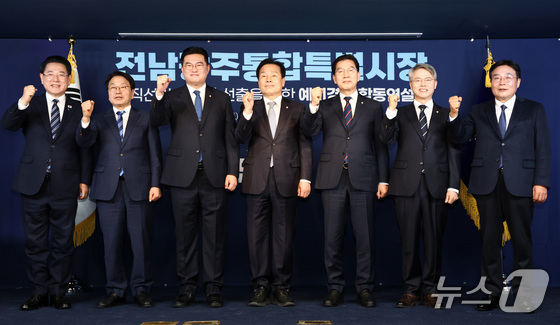
Ahead of the June 3 local election to choose the inaugural mayor of the Jeonnam–Gwangju Special City, the Democratic Party held the first stage of its primary contest with a joint preliminary speech session.
Although the event was structured as policy presentations rather than a debate, candidates spoke forcefully and sought to demonstrate why each is best suited to become the area’s first special-city mayor.
The Central Party Election Commission hosted the session at the Democratic Party headquarters in Yeongdeungpo-gu, Seoul, at 2 p.m. on the 14th.
The speaking order was: No. 3 Jeong Jun-ho; No. 6 Min Hyung-bae; No. 4 Joo Cheol-hyun; No. 7 Lee Byung-hoon; No. 2 Kang Ki-jeong; No. 1 Kim Young-rok; and No. 5 Shin Jeong-hoon.
Each candidate screened an introduction video of roughly one minute, then delivered a seven-minute policy address.
Their campaign slogans, by ballot number, were: No. 1 Kim Young-rok — “The integrated special-city mayor the president wants”; No. 2 Kang Ki-jeong — “Someone who will make the president and the Democratic Party shine”; No. 3 Jeong Jun-ho — “The planner of integration, a new leader for Honam”; No. 4 Joo Cheol-hyun — “I will build a Jeonnam–Gwangju that can compete with Seoul”; No. 5 Shin Jeong-hoon — “Lee Jae-myung’s promise, one of our side”; No. 6 Min Hyung-bae — “The integrated special city the president backs — Min Hyung-bae will do it”; No. 7 Lee Byung-hoon — “A prepared candidate with experience across Jeonnam, Gwangju, and the center.”
Jeong Jun-ho, the first speaker, emphasized that he authored the original bill to establish the Jeonnam–Gwangju integration law and framed himself as a candidate of generational change in his 40s.
Jeong said that while other candidates were content with the government support package of 20 trillion KRW (about $136,000,000), he had even sought an extra 30 hundred million KRW (about $2,040,000) for areas where integration stalled, a move that surprised the TK. He argued that, in a bases-loaded situation, the region needs a clutch player who can pressure opponents and produce big results, not veteran figures whose weaknesses are already exposed.
Min Hyung-bae said the special-city mayor must know the president so well they can communicate with a glance, and vowed to move immediately to implement the integration successfully. On the 20 trillion KRW government package (about $136,000,000), he proposed allocating 80% to infrastructure for attracting advanced firms, 10% to talent development, and 10% to building social safety nets.
Joo Cheol-hyun highlighted his role in supporting Lee Jae-myung’s political rise and pointed to his record as mayor of Yeosu, where he repaid 99 billion KRW (about $67,320,000) in debt and helped transform the city into a maritime cultural destination that draws 13 million visitors annually under the “Yeosu Romantic Night Sea” brand. He pledged to distribute the second wave of public institution relocations from Seoul across eastern and western Jeonnam and Gwangju to build regionally appropriate industrial bases.
Lee Byung-hoon recalled that at 38 he served as mayor of Gwangyang County and led the merger of Donggwangyang City and Gwangyang County. He cited roles during the Yeosu Expo and as Gwangju’s deputy mayor for culture and economy, including helping attract a Hyundai plant. “I’ve long wondered why our democratic heartland lags in development and why it can’t become a prosperous democratic city,” he said, adding that as the only candidate with administrative experience in both Gwangju and Jeonnam, he will deliver results.
Kang Ki-jeong framed himself as a leader defined by drive, listing major projects he pushed as mayor: relocating Gwangju’s military airport, initiating a mixed-use mall, and completing road paving tied to above-ground subway construction. He contrasted his decisive approach with officials who delay decisions, arguing that integration is not a rosy vision but a difficult task that requires determined leadership.
Kim Young-rok said the first special-city mayor must produce a clear vision within a six-month “golden window.” He argued that the role requires someone already familiar with Jeonnam and Gwangju who needs no rehearsal. Citing his record — ranked first in a 66-month regional executive performance evaluation and top-rated for fulfilling gubernatorial pledges — Kim asked for the opportunity, saying his administrative experience spans both national and local levels.
Shin Jeong-hoon recounted that, as a high school junior during the May 18, 1980, Gwangju uprising, he vowed to correct state power and later led protests at the U.S. Cultural Center in Seoul as a university student to expose the massacre, for which he served time. Carrying that conviction into public service, he served as a provincial assembly member, mayor of Naju, a three-term member of the National Assembly, and chair of the Public Administration Committee, where he helped secure the Jeonnam–Gwangju integration. He pledged to revive the regional economy by organizing development around three zones and seven major economic axes.
The Democratic Party will select its nominee for the Jeonnam–Gwangju integrated special-city mayor through staged contests: a preliminary primary on March 19–20, a main primary on April 3–5, and a final run-off on April 12–14.







Most Commented