
Translation result
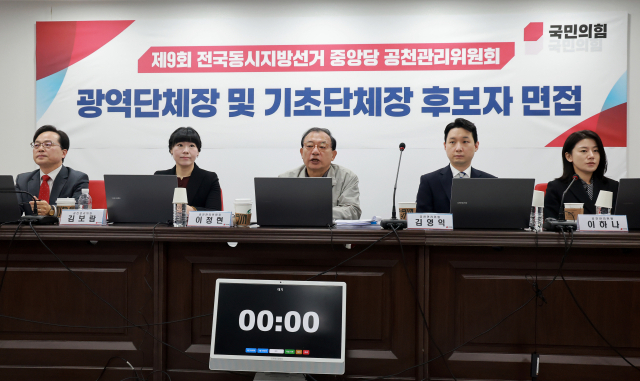
The People Power Party’s preliminary contest to nominate its candidate for governor of North Gyeongsang Province (Gyeongbuk) reaches its climax this week. After a vision debate among preliminary candidates on the 16th, voters will select one winner to advance to the main primary in voting scheduled for the 18th–19th.
The five preliminary candidates—Kim Jae-won, Baek Seung-joo, Lee Gang-deok, Im E-ja and Choi Kyung-hwan (in Korean alphabetical order)—will face off at the vision debate at party headquarters on the 16th. They will present development blueprints for Gyeongbuk, answer questions on local issues and engage in moderated exchanges.
As the only debate held immediately before voting, the event is expected to be a high-stakes contest as candidates try to win over undecided party voters. The preliminary outcome will be determined by a 70% delegate vote and 30% public-opinion polling.
While candidates must mobilize their core supporters to advance to the final primary, the eventual winner will also need to absorb the supporters of eliminated rivals. For that reason, observers expect contenders to emphasize clear policy positions on regional issues rather than launch overtly aggressive attacks at the debate.
The People Power Party’s nomination committee frames the system as a fair competition designed to put the strongest candidate before voters and to give challengers a genuine opportunity to overcome the incumbency premium.
Analysts say the preliminary victor could enjoy a winner’s-momentum effect after prevailing in a five-way contest. If challengers jointly advance a narrative of replacing the incumbent, support may consolidate around the survivor.
Conversely, if challengers turn the preliminary into an all-out mudslinging fight, any victory could leave lasting scars and make the final contest against the incumbent more difficult.
Local political observers say the preliminary effectively functions as a de facto ‘anti-Lee Cheol-woo’ unification, so its impact could be substantial. With party sentiment carrying 70% of the weight, the decisive factor will be who can mobilize the traditional base.
Incumbent Gyeongbuk Governor Lee Cheol-woo will skip the debate and meet challengers only in the final primary under the \”Korea Series\” format. Like sports playoffs that identify the strongest team, challengers first compete among themselves to select the strongest candidate, who then faces the incumbent in the final showdown.
This week Lee completed his preliminary registration and launched a full campaign for a third term.
The preliminary winner and Lee will campaign from the 26th to the 28th, with voting set for the 29th–30th. The final nominee will be chosen by an even split—50% delegate votes and 50% public polling. Given Gyeongbuk’s reputation as a conservative heartland, winning the party primary is likely to translate directly into general-election competitiveness.
A People Power Party official said many expect the incumbent—who has spent years organizing his network and building name recognition—to have an advantage. The official added that the party hopes the preliminary contest among challengers will boost turnout and challenger competitiveness, but because this approach is new, the outcome is difficult to predict.








Most Commented