
Translation result
|
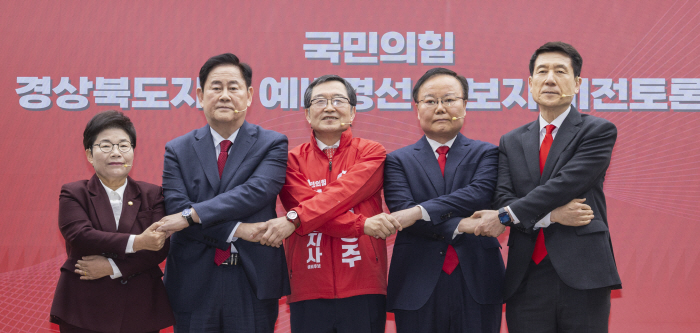
The People Power Party’s so-called \”Korean Series\” to select its nominee for governor of North Gyeongsang Province has entered a decisive phase. At a vision debate where candidates outlined their policy proposals, they found common ground on the need to attract advanced industries such as artificial intelligence and semiconductors, but sharply diverged on how to accomplish that.
Notably, former Deputy Prime Minister Choi Kyung-hwan proposed at the previous day’s debate to disperse and relocate part of the Yongin semiconductor cluster to North Gyeongsang. Rep. Im Ee-ja pushed back, saying much of that project is already finalized, making partial relocation unrealistic, and argued it would be more practical to pursue a new national project.
On the 17th, a People Power Party official said that, regardless of whether a partial relocation is feasible, the crucial point is that reviving North Gyeongsang’s sluggish economy requires attracting new industries and securing fresh growth engines. The official added that this does not necessarily mean taking part of the Yongin cluster and emphasized that North Gyeongsang already has well-developed industrial infrastructure, including strong energy self-sufficiency, and that the new governor and local lawmakers should work together to create the conditions to attract new industries.
The same issue reappeared during the post-debate Q&A with reporters. Choi argued that Yongin faces limits in water and power supply, which justifies a dispersed deployment; he said North Gyeongsang has roughly a 70% surplus in industrial water and can draw power from nearby nuclear plants, making it an optimal location.
Rep. Im responded that similar relocation proposals surfaced ahead of local elections in the Honam region—most notably suggestions to move projects to Saemangeum—but the government ruled them out and companies refused. Given that Yeongnam already hosts many new-materials firms, she argued the region should pursue the still \”blue-ocean\” field of strategic semiconductors, and she proposed targeting a government-backed AI national project scheduled for July as an alternative.
Historically, Daegu and North Gyeongsang (the TK region) have been regarded as areas where a conservative party nomination effectively guaranteed victory. But recent polls showing the Democratic Party leading have prompted the People Power Party to invest more effort even at the nomination stage. As a conservative stronghold, TK is among the regions with the most PPP primary applicants, and it was one of the first areas to make its nomination process public.
The People Power Party’s Nomination Management Committee said it will run the Gyeongsangbuk-do gubernatorial contest in a \”Korean Series\” format. Five preliminary candidates—Kim Jae-won, Baek Seung-joo, Lee Kang-deok, Im Ee-ja, and Choi Kyung-hwan—will participate in the initial round; the field will then be narrowed to a single contender through opinion polls and a public participation vote on the 18th–19th. That candidate will face incumbent Governor Lee Cheol-woo in a final primary to determine the party’s nominee.
A People Power Party official said that, with many other issues on the party’s agenda, the Gyeongsangbuk-do nomination is proceeding according to established procedures and that, overall, the process is moving relatively smoothly.








Most Commented