
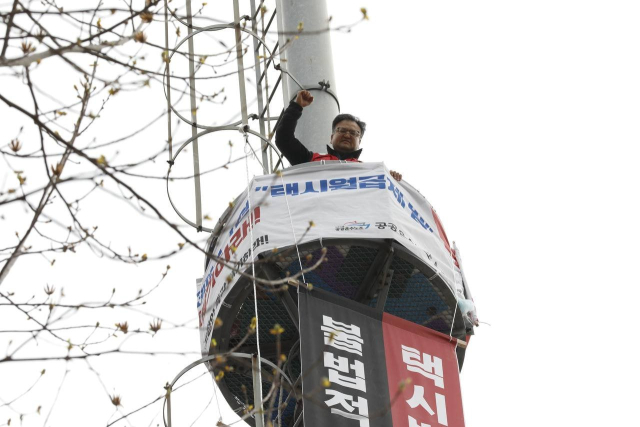
A taxi driver climbed a telecom tower in front of the district office of the National Assembly’s Land, Infrastructure and Transport Committee chair and began a high-altitude protest, demanding the withdrawal of a bill that would roll back the taxi-salary system introduced to stabilize taxi drivers’ livelihoods.
On the 30th, the Public Transport Workers’ Union held a press conference in front of Rep. Maeng Hyung-kyu’s (Democratic Party) Incheon district office, urging the National Assembly to scrap the proposed amendment to Article 11-2 of the Taxi Development Act now pending in the legislature. Since the day before, Go Young-gi, head of the Daelim Transportation sub-branch of the taxi union’s Jeonbuk chapter, has been staging a high-altitude protest atop a telecom tower about 20 meters (roughly 66 feet) high near the office.
Article 11-2 of the Taxi Development Act requires taxi companies to set drivers’ working hours at “at least 40 hours per week.” Seoul already enforces the rule, and other regions had been scheduled to begin implementation in August.
The provision aims to stabilize taxi drivers’ livelihoods. Because it is difficult to measure exact working hours in the taxi industry, the sector uses a “deemed working-hours” system in which labor and management agree on hours. If those hours are set too low, wages are reduced accordingly.
For that reason, Article 11-2 has been viewed as central to implementing the so-called taxi-salary system: if drivers’ hours are set at “at least 40 hours per week,” companies are required to pay a corresponding fixed salary.
However, an amendment jointly proposed by Rep. Son Myeong-su (Democratic Party) and Rep. Kwon Young-jin (People Power Party) would allow, with a labor-management agreement, up to 40% of all licensed taxis to have weekly working hours set below 40 hours. The bill would also delay implementation outside Seoul by an additional two years.
Speaking to Pressian, Go criticized the amendment as “an absurd bill that would make some drivers receive the minimum wage based on a 40-hour week while others wouldn’t even get the minimum wage.” He said that after Kim Jae-ju, then head of the taxi union’s Jeonbuk chapter, staged a 510-day high-altitude protest in 2019 and the taxi-salary law was enacted, drivers living in hardship had waited more than five years for implementation. “Seeing not just a delay but a rollback made me conclude that dialogue wouldn’t resolve this, so I climbed up,” he said.
Choi Se-ho, head of the taxi union, said reporters asking about changes after the system began in Seoul heard many drivers say that working 40 hours a week and being guaranteed a minimum wage above 2,000,000 KRW (about $1,500) encouraged law-abiding driving and friendlier service to passengers, and that drivers get an extra hour or two of sleep. “The taxi-salary law strengthens road safety,” he emphasized.







Most Commented