
Translation result.
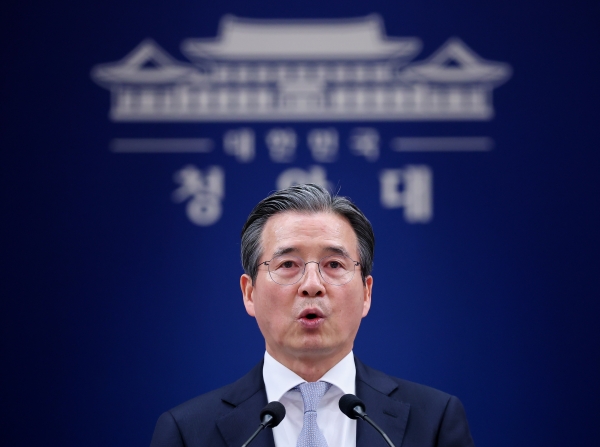
The fallout from a Facebook post by Kim Yong-beom, the Blue House policy chief, proposing a “citizen dividend” continues to reverberate. Coverage ranged from a Bloomberg analysis that linked a market dip to his post to domestic outlets that simply repeated that claim. As those quick, quote-driven stories proliferated, more serious public discussion about how to manage excess profits in the AI era faded from view.
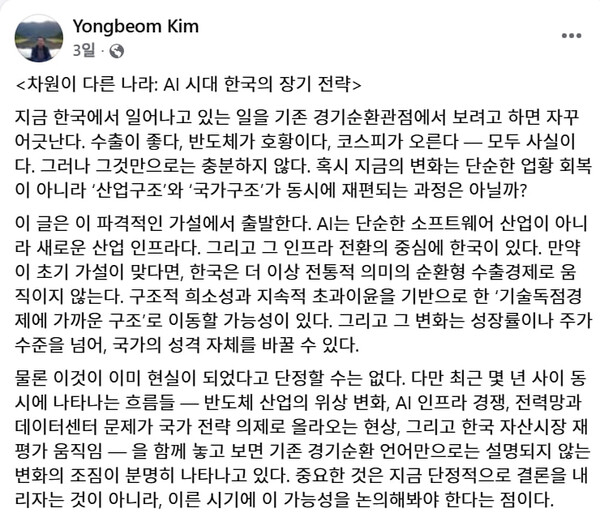
Kim’s 5,648-character post centers on a technology-monopoly economy
On the 11th, Kim published an essay on Facebook titled A Country on a Different Level: South Korea’s Long-Term Strategy for the AI Era. He argued that South Korea could move beyond the familiar boom-and-bust cycle and reorganize into a technology-monopoly economy capable of generating sustained excess profits.
Kim’s post runs 5,648 characters (excluding spaces), roughly 43.5 manuscript pages by the 200-character standard. The contentious “citizen dividend” appears about three-quarters of the way through. His argument was that if Korea shifts into a technology-monopoly structure and accumulates large excess profits, some of those gains could be used to blunt the K-shaped divergence—widening inequality across classes and industries—that is a growing global concern.
The biggest problem facing Korea now isn’t just simple fiscal soundness. The excess profits of the AI era could structurally widen the K-shaped gap within society. If so, using part of those excess gains to support current-generation social stability and to ease transition costs would not be mere redistribution but a cost of maintaining the system.
There are reference models. In the 1990s, Norway put oil revenues into a sovereign wealth fund and designed rules to return investment income to society. They turned a resource windfall into long-term social capital rather than treating it as a one-time gain. Korea’s situation differs in character, but the question is the same: how do you institutionalize structural excess profits? In this piece I propose the working name “citizen dividend” for that principle.

Kim framed the citizen dividend as one institutional approach to channel structural excess profits for social use. Critics portrayed the idea as a government seizure of corporate profits, which fueled controversy. But Kim explicitly tied the proposal to excess tax revenue.
If a strategic position in the AI infrastructure supply chain creates a structural boom that produces record excess tax revenue—how to spend that money becomes a design question we must address, not merely a policy choice. … One point I want to make clear: debates about program design only matter after you accept the premise. Skipping that argument and arguing only over specific programs is unproductive. If excess tax revenue never appears, the citizen dividend is fanciful. But if the premise holds, letting those excess gains slip away without principle could be the more irresponsible choice.
Did ‘citizen dividend’ claims trigger the KOSPI drop? Is Bloomberg right?
Kim posted at 10:08 p.m. on the 11th. Coverage began pouring in around 7 a.m. the next morning (the 12th). Headlines included Kim Yong-beom: AI gains should return structurally to all citizens (Korea Economic, May 12, 7:39 a.m.), Kim Yong-beom: We should debate a citizen dividend on AI excess profits…Korea heading toward a technology-monopoly economy (Asia Economy, May 12, 7:39 a.m.), and Blue House policy chief Kim Yong-beom floats ‘citizen dividend’: semiconductor boom could create structural excess profits (Hankook Ilbo, May 12, 8:17 a.m.).

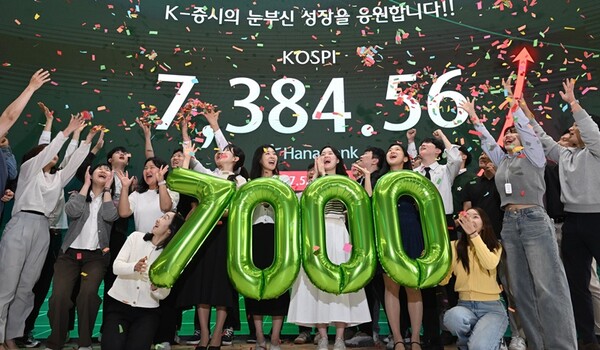
On the 12th, the KOSPI opened above 7,900 at 9 a.m., fluctuated, and turned downward around 10 a.m. By about 10:30 a.m., it had fallen toward 7,500, and around 10:40 it dipped to about 7,400. At 10:50 a.m., as the index was recovering toward the 7,600 range, Bloomberg ran a story headlined Korea Roils Market by Floating ‘Citizen Dividend’ From AI gains. After that piece, the index retreated toward 7,500 and closed the day at 7,643.
Bloomberg reported that a senior South Korean policymaker had suggested using tax revenue from the AI industry to pay dividends to citizens, and that the market reacted. The article’s body did mention tax revenue, but the headline emphasized AI gains, which likely led readers to misinterpret the claim. Bloomberg later changed the headline to AI Tax and subsequently removed the Tax reference altogether.
Several observers disputed Bloomberg’s causal claim. It’s true that Samsung Electronics and SK Hynix—companies central to the excess-profits discussion—saw heavy selling after Kim’s post. But markets in Japan, Taiwan and Singapore also moved sharply lower at the same time. Some analysts argued that a larger factor was at play: U.S. President Donald Trump had criticized an Iranian peace proposal, raising concerns that the conflict could harden again, and that fear may have had a stronger effect on the sell-off.
Kim Won-jang, head of an economic research institute, told MBC radio on the 14th that Bloomberg’s thesis would imply Kim’s proposal caused sell-offs in the Nikkei, Taiwan’s weighted index and Singapore’s STI as well. He noted that around that time President Trump had dismissed the Iranian proposal, which raised fears of a tougher stance. Our market opened amid that global concern, retail investors pushed prices up, and foreign investors sold to rebalance—so war-related worries clearly factored into the moves, he said.
By the time Bloomberg published, the market had already passed its low and was on a rebound. The Blue House sought to contain the fallout around 5 p.m., saying Kim’s Facebook post reflected his personal view. If foreign investors had unloaded stocks solely over fears of a citizen dividend plan, it is hard to explain why the market began rebounding before that concern eased. A more complex combination of factors appears to have been at work.
Professor Woo Seok-jin of Myongji University told broadcasters that Bloomberg’s story used tax revenue in the text but ran gains in the headline, making the coverage resemble a misreport. He also noted that fund managers often assign a fixed regional allocation—say 5% to Korea—and when the KOSPI rises past that allocation they sell to rebalance, a dynamic that can amplify declines.
‘Quote journalism’ buries the agenda for future generations
What turned Kim’s post and Bloomberg’s analysis into a political firefight was the media’s reliance on quote-driven reporting. Immediately after Bloomberg published, dozens of outlets ran headlines such as Bloomberg: KOSPI plunge caused by Kim Yong-beom’s ‘citizen dividend’ remark. According to the Korea Press Foundation’s BigKinds news-data system, 121 articles published between the 12th and 15th used Kim Yong-beom and Bloomberg as intersecting keywords. Most simply quoted the foreign report without independent evaluation.

The opposition People Power Party labeled the idea socialist or communist. Critics also had a point that a senior Blue House official should choose his words carefully on personal social media. But because Kim specified the proposal would hinge on excess tax revenue, claims that the government would simply seize corporate profits and redistribute them were a politically motivated framing. Still, dozens of headlines simplified the issue into lines such as Kim Yong-beom: Use AI profits for a citizen dividend and Ahn Cheol-soo: Citizen dividend? Communist idea…If you want dividends, buy stock.
President Lee shared a Korea Economic TV article on X on the 13th and wrote that Kim said he would review a plan to distribute the state’s excess tax revenue generated by AI-sector excess profits as a citizen dividend. He added that some outlets edited the remark to claim Kim argued for distributing corporate excess profits, calling that slanderous fake news. Kim denied that interpretation and clarified the proposal centered on excess tax revenue, yet the misleading coverage kept circulating. The president titled his post No fake news for manipulating public opinion.


After the president’s X post, Korea Economic TV removed its article. While its Venezuela comparison did not necessarily meet the technical definition of deliberate fake news, the episode shows how careless, quote-focused reporting can obscure the issue and amplify partisan conflict. Kim’s intent was to prompt social discussion; instead, debate devolved into whether his post had knocked down stock prices.
If structural excess profits arise, debating how to address them is a necessary public task. Analysts have long warned that rapid productivity gains from AI could fundamentally alter work and income. In April, Elon Musk suggested on X that a Universal High Income could offset AI-driven job losses—an idea in the same vein. Bill Gates’ proposal for a robot tax to support workers displaced by automation also intersects with Kim’s concerns. When the media reduces these debates to headlines and soundbites, an important policy agenda for current and future generations drifts out of view.









Most Commented