
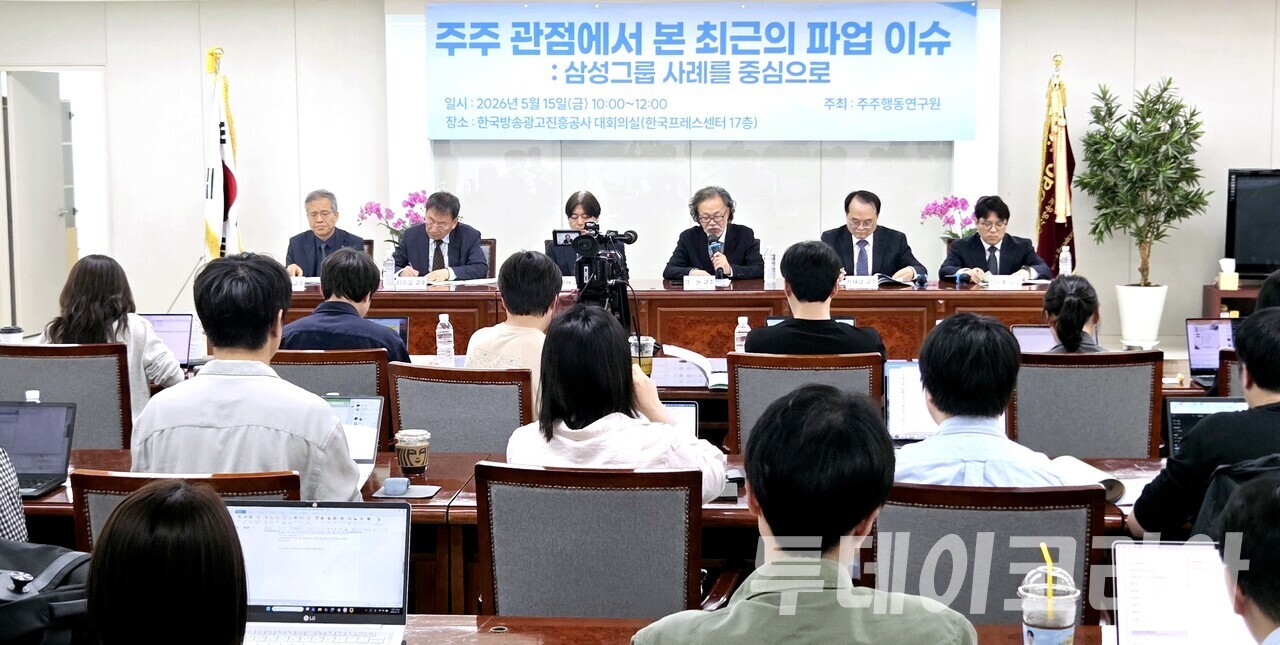
TodayKorea — Reporter Ahn Hyun-jun | Legal scholars warned that a proposal from unions at Samsung Electronics and Samsung Biologics to guarantee performance bonuses tied to operating profit could undermine the foundations of shareholder capitalism under corporate law. They cautioned that a structure allowing unions to secure a fixed share of operating profit could harm shareholders’ rights and damage the company’s long-term growth engine.
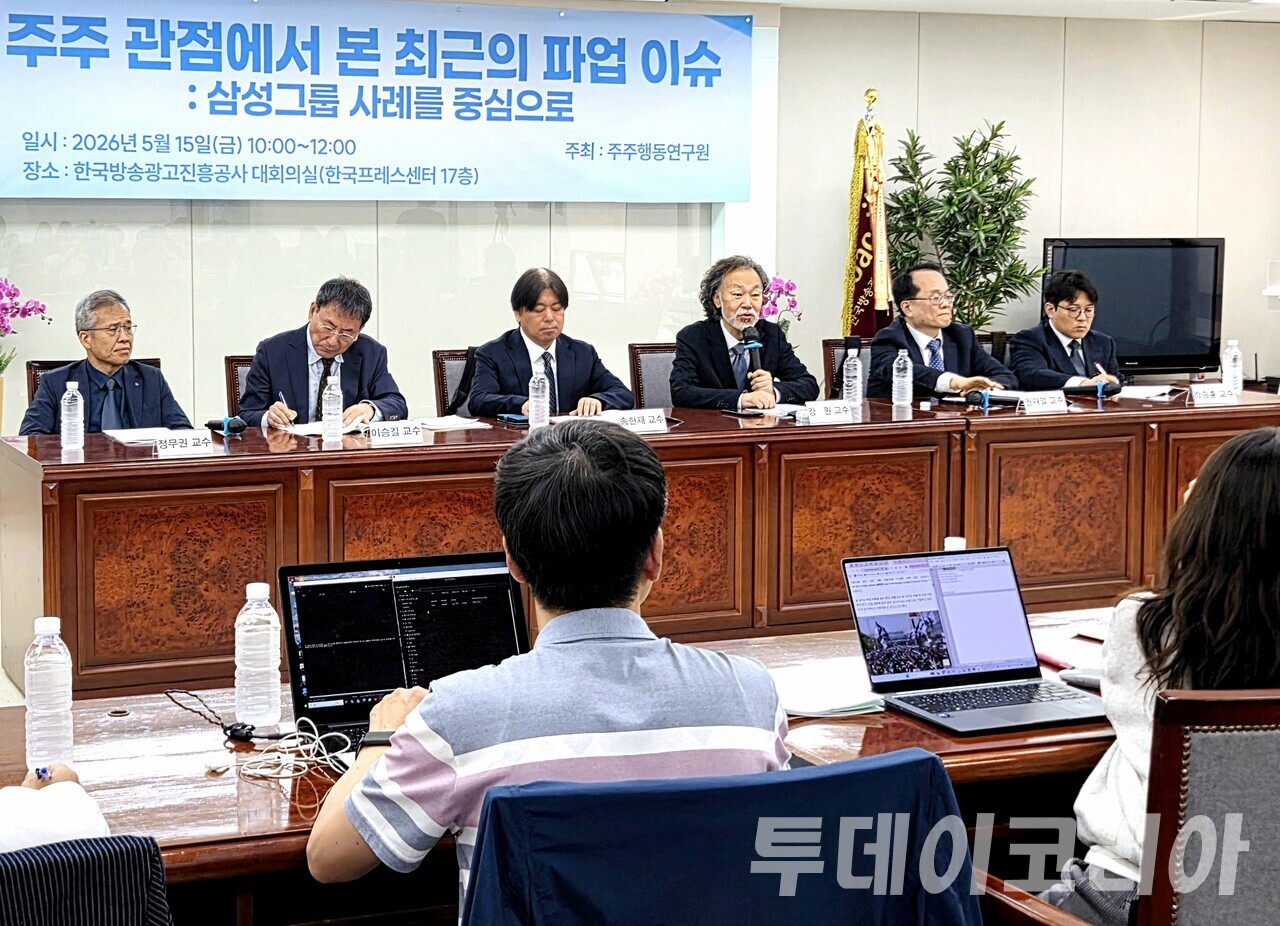
Professor Kwon Jae-yeol of Kyung Hee University’s School of Law told a Shareholder Action Research Institute (SERI) forum at the Press Center in Jung-gu, Seoul on the 15th that company profits are not determined solely by short-term returns.
He warned that applying a rigid formula to calculate bonuses would pressure management to chase short-term results, which would ultimately be detrimental to employees as well.
He also raised concerns from a corporate law perspective.
He said, \”From the standpoint of corporate law, operating profit belongs to shareholders, and the disposition of profits is, in principle, a matter for a shareholders’ meeting resolution.\” He added, \”Operating profit is fundamentally an accounting concept used to measure corporate value, not a mechanism to automatically calculate wages.\”
He strongly criticized the proposal: \”Forcing a fixed percentage of a company’s operating profit into a collective agreement would mean shareholders bear the risk of losses while workers secure fixed residual profits. That effectively elevates workers to the status of residual claimants and directly conflicts with traditional corporate company doctrine.\”
He also warned that the union’s demand for prior consent rights over broad personnel systems, mergers and acquisitions, and the introduction of new machinery or technology could infringe on the board’s exclusive authority.
Professor Kwon noted, \”Mergers, divisions, and transfers require a board resolution followed by a special shareholders’ resolution under the Commercial Act (Article 522, etc.).\” He said the union’s demand for prior agreement would distort the decision-making structure established by law.
On the request to allocate treasury shares, he observed that a company can acquire treasury stock only if it has distributable profits, and he warned, \”The bio industry can experience large swings in performance and financial condition depending on market cycles, regulation, and clinical outcomes, so it’s unrealistic to guarantee that distributable profits will always be sufficient.\”
He added, \”If a company spends too much on buybacks, it may cut R&D investment and harm long-term growth. Using treasury shares for employee compensation faces practical hurdles: firms would need annual shareholder approval to retain and dispose of such shares, which makes it difficult to persuade shareholders.\”
In particular, Professor Kang Seung-hoon of Inha University’s Department of Bio-Pharmaceutical Engineering issued a stark warning about the risks a strike poses to the bio industry, which is tightly regulated across drug development, manufacturing, and distribution.
Professor Kang said, \”Biologics, especially antibody drugs, are produced using living cells, so maintaining continuous, uninterrupted processes is essential. If production stops or supervisory gaps occur, the risk of quality degradation rises significantly.\”
He noted, \”Most domestic biopharma firms develop and produce their own products, but Samsung Biologics operates as a CMO or CDMO that manufactures for global pharmaceutical companies. Timely delivery and consistent quality are core to that business model. If a labor dispute interrupts supply, global clients will immediately seek alternatives, which could threaten the company’s survival.\”
He added, \”In global markets that prioritize stable drug supply, companies with frequent labor disputes and habitual supply interruptions will not be entrusted with contract manufacturing. Over the long term, such firms risk being pushed out of the market.\”
He warned that if stakeholders come to believe a company cannot guarantee stable production and supply, the competitiveness of Korea’s entire CDMO industry could suffer. He urged that the issue be seen not merely as a labor dispute but in terms of the global pharmaceutical supply chain and patient-care stability.
Amid these discussions, participants also called for debating whether the semiconductor industry should be designated as essential maintenance work under current labor law.
Lee Seung-gil, president of the Korea ILO Association, emphasized, \”Under current law, the semiconductor industry does not qualify as a public service or essential public-interest operation, so replacement workers cannot be compelled during strikes. Because halting a semiconductor production line requires enormous time and cost to restore and could sever the lifeblood of the national economy, we must discuss designating it as essential maintenance work.\”
This article was written on site.






Most Commented