
Discover Incheon’s Hidden Gems: How the i-Sea Pass Revolutionizes Island Access in 2026
Daniel Kim Views

There are 192 islands scattered off Incheon’s coast — 40 inhabited and 152 uninhabited. Steep ferry fares and the hassle of crossing the water kept most people from visiting for years.
That’s starting to change. Early last year, coastal ferry fares were cut to near–public-transit levels, and Incheon’s marine tourism scene is showing new life.
At the center of that shift is the city’s fare-subsidy program, the i Sea Pass. Combined with island-friendly initiatives, it’s turning distant isles into easy, desirable day-trip destinations.

▲ Islands feel closer with the i Sea Pass — visitors are flocking
Baengnyeongdo, the northernmost island in the Yellow Sea, is one of the big winners. It lies roughly 220 km (about 137 miles) from the mainland and still takes about four hours by high-speed ferry.
At a standard fare of 75,900 KRW (about $56.93), trips used to be a budget-busting splurge for many. Since the i Sea Pass launched last January, Incheon residents can ride for just 1,500 KRW (about $1.13), dramatically improving access.
The pass expanded fare benefits that had been limited to island residents to the entire Incheon population. It covers ferries serving 25 islands in total — 20 in Ongjin County and five in Ganghwa County.
Non-resident visitors have surged as well. The city raised the discount for outsiders from 50% to 70%, cutting travel costs and making island getaways much more appealing.
The numbers back it up: coastal ferry ridership reached 2,086,564 last year — an 11% increase from 1,882,930 in 2024.
Non-local passengers numbered 133,248, up 48% (42,880 people) from the previous year, underlining the program’s draw for outside tourists.
Riding that momentum, the city will continue the fare-support program this year. National, city, and county funds will supply 20,268,000,000 KRW (about $15.2 million) to the i Sea Pass.
More visitors haven’t come without cost: some islands report illegal dumping and unauthorized foraging of wild greens, sparking concern among residents.
To address those issues, the city plans an “i Sea Guardians” initiative to crack down on illegal harvesting and littering and to strengthen visitor etiquette.
A city official said, “The i Sea Pass has set a new standard in maritime transport policy and is being recognized as a national model. We will keep developing and expanding policies that enhance the value of Incheon’s islands and link tourism growth to local economic development.”
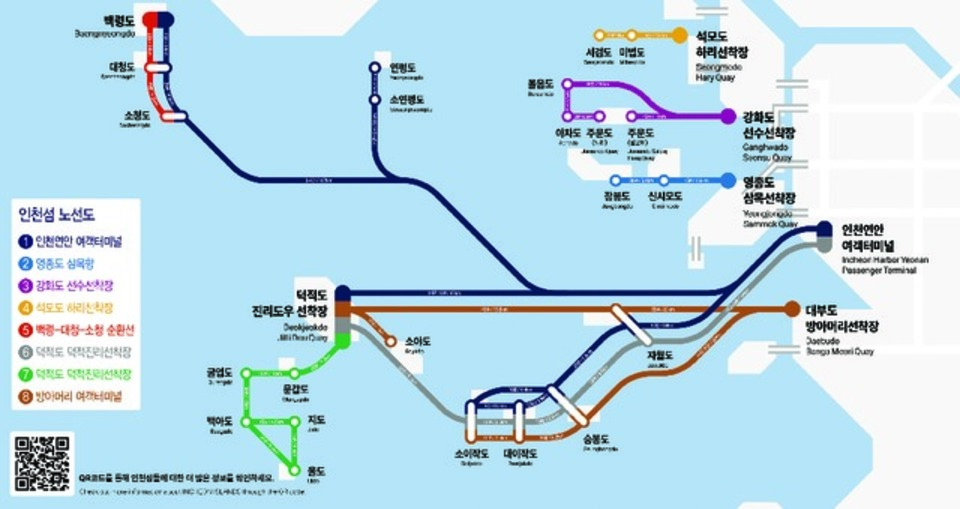
▲ Incheon island route map — see your options at a glance
The city also created the Incheon Island Route Map, a clean visual guide that shows each island and the best ways to get there. The goal: reframe islands from remote chores into accessible lifestyle destinations.
The project moved forward after winning a 2023 regional specialization grant from the Ministry of the Interior and Safety. From October 2024 to January this year, the city invested 1,000,000,000 KRW (about $750,000) to develop a unified brand and build the route map.
The plan is to connect key tourist islands under a single Incheon Islands brand. Officials settled on the name Incheon Islands and the slogan Incheon Islands — At Your Doorstep to keep the message simple and memorable.
The new map visually simplifies ferry schedules and routes so island hopping feels straightforward and low-effort.
City leaders expect the map to magnify the i Sea Pass’s impact. If the pass made islands easier to reach, the map shows visitors exactly where to go and how to get there.
The city is also piloting real-world branding on Deokjeokdo: sprucing up the Jinri Port pier gate, improving signage at the Deokjeokdo Sea Station, and creating symbolic hubs to give the island a clear identity. Officials say they preserved existing structures while refreshing colors and design to improve first impressions.
To boost access further, the city plans to expand the map’s reach. It’s partnering with the Incheon Tourism Organization and the Incheon Port Authority to develop a mobile app and enhance passenger terminal facilities as follow-up projects.

▲ Treasure Island 119 Panorama — island tourism goes digital
The city is also using digital tools to broaden who can experience the islands.
Last year it launched the Treasure Island 119 Panorama, a virtual platform that lets people explore island highlights without traveling in person.
Using drones and 360-degree cameras, the project captures key sights and stitches them into panoramic videos for immersive virtual tours.
The virtual tour covers 14 islands across three townships in Ongjin County — Deokjeok, Jawol, and Bukdo — chosen as representative island destinations. Citizens can access the Treasure Island 119 Panorama via the city’s map portal.
The city promoted the platform at events last year, running booths at K-GEO Festa and Incheon Citizens’ Day where about 1,800 people tried the content. Officials also brought VR experiences to the coastal passenger terminal to reach more users.
A city satisfaction survey found 84 of 95 respondents were “very satisfied” and 11 were “satisfied,” showing overwhelmingly positive feedback.
The city plans to keep the VR service running while expanding content and promotion.
A city official said, “We will actively showcase Incheon’s beautiful islands and expand smart tourism services so more residents can experience them.”
/By A-jin Lee atoz@incheonilbo.com









Most Commented