
Is Daejeon’s Polling Biased? Examining the Controversial Survey Methods Behind 2026 Election Results
Daniel Kim Views
Translation result.
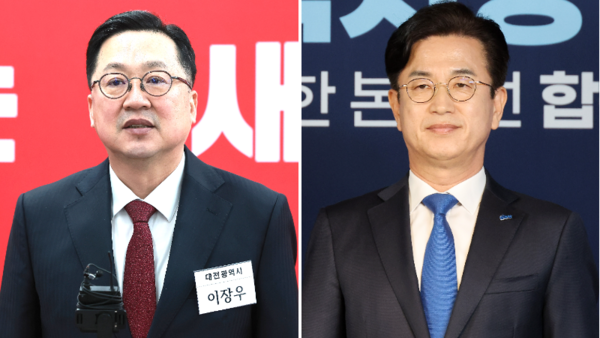
[The Public=Reporter Kim Jong-yeon] Political and local officials have alleged that a poll commissioned by a regional private broadcaster was designed in a way that favored a specific candidate.
On the 21st, based on statements from political circles and local leaders, critics said that the Daejeon mayoral survey TJB commissioned from Jowon C&I and Research & Research, conducted April 18–19, showed structural bias in the order of its questions.
TJB contracted Jowon C&I to survey 800 Daejeon residents aged 18 and older using computer-assisted telephone interviewing (CATI) that relied entirely on virtual mobile numbers. The sample was selected by proportional random sampling by sex, age group and region. Interviewers attempted 6,983 calls and completed 800 interviews, yielding an 11.5% response rate. The margin of error is ±3.5 percentage points at the 95% confidence level.
The poll put Democratic Party candidate Heo Tae-jeong at 46.3% and incumbent Mayor Lee Jang-woo of the People Power Party at 22.9%, a 23.4–percentage-point gap. TJB reported that Heo led outside the margin of error. When asked who was most likely to win, 58.6% of respondents chose Heo and 20.4% chose Lee.
Kim So-yeon, a lawyer who served as a legal special adviser to the Daejeon city government and now works at Hwang & C, posted a photo of the original questionnaire on her Facebook page and criticized the poll as manipulation rather than a faithful measurement of public opinion.
She argued that bias is evident from the survey’s design and question order to the interpretation of the results. She charged that behind the responses of the 800 citizens, the poll designers’ predetermined intentions are plainly visible.
Kim’s primary objection was the sequence of questions. According to the original questionnaire, demographic questions (SQ1–SQ3) are followed immediately by Q1 on party support. After asking which party respondents back, Q1-1 asks which party they feel favorably toward. Q2 then asks, “How do you evaluate President Lee Jae-myung’s administration?”
Q3 asks, “Which of the following major issues in this local election do you consider most important?” The answer choices include “support for the government” and “checking the administration.” Only after these three items does Q4 present the core question: “Who do you think is best suited to be the next mayor of Daejeon?”
Kim said this order appears to deliberately exploit what survey methodology calls the priming effect. Priming occurs when asking respondents to think about a particular topic first shifts their judgments on subsequent questions in that direction.
She argued that asking about support for the government at a time when presidential approval is relatively high creates a psychological pathway that nudges respondents toward a particular mayoral choice. That, she said, is a clear example of leading questions that infringe on citizens’ ability to choose objectively. She added that this absurd approach—blowing central political winds into a local mayoral contest—insults the pride of Daejeon residents.
Kim also criticized how the poll results have been used. Inflating support in an initial poll after candidates are confirmed can create seriously distorted perceptions among citizens, she said. The polling firm claims it can “predict tomorrow from today,” but in reality it manipulates today to manufacture the tomorrow it prefers. She warned that reporting both candidate suitability and electability together can trigger a bandwagon effect, which would further exaggerate the apparent gap.
“Daejeon is not a city that can be easily swayed,” she said. “Whatever the national winds, Daejeon residents judge by what they see on the ground. Citizens who have watched the last four years and the mayor’s record closely will not be shaken by these numerical tricks.”
Kim urged the National Election Survey Deliberation Commission to initiate an immediate and thorough review of the survey’s design. She also called on media outlets, including TJB, to stop reporting results within the margin of error as a candidate’s definitive “lead.”
By contrast, a TJB survey the same firm conducted in October last year showed a close race: Lee at 25.0% and Heo at 22.0%. That earlier poll used a wireless ARS method; this one used CATI phone interviews, so the methodology changed.
While factors such as a change in national government and the Democratic Party’s nomination help explain why the gap widened from 3 percentage points to 23.4 percentage points in six months, analysts say the impact of changes in survey methodology and question design also warrants close scrutiny.








Most Commented