
How the New Electricity Law Will Save Jobs in Pohang’s Steel Industry: A Must-Read Guide
Daniel Kim Views
Translation result
[iNews24 reporter Jinwoo Lee] Park Hee-jeong, the Democratic Party candidate for mayor of Pohang, pushed the ruling party to introduce an amendment to the Electric Utility Act that would mandate reduced electricity rates for the steel industry.
On the 28th, Park held a press conference at the National Assembly with Min Byung-duk, chair of the Democratic Party’s Euljiro Committee. She said, “Pohang’s growth was built on the steel industry, but the city now faces a complex crisis driven by international competition, oversupply, weakened demand, and the costs of transitioning to carbon neutrality. Above all, the burden of electricity costs directly affects steel production costs, plant operations, and workers’ jobs.”
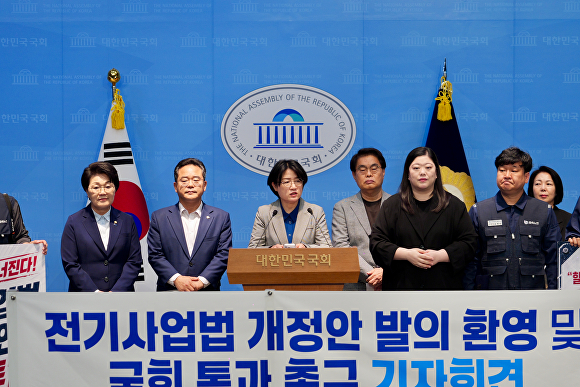
Park emphasized that lowering electricity rates is not a policy pursued “if possible” but a basic safeguard to protect employment and local economies in crisis. She said the bill was revised to strengthen its enforceability so it will work effectively on the ground.
Representative Min, who led the bill’s introduction, said he visited Pohang in February 2026 for discussions with labor unions and held a labor-management meeting at the National Assembly in March to hear urgent concerns from the field. He stressed that global oversupply and cheap steel imports have pushed down selling prices while raw material costs have risen and electricity prices have not fallen.
He added that raw material and selling prices are driven by international market forces, but electricity rates can be adjusted through domestic policy. “Submitting the bill is only the beginning,” he said. “I will shepherd it through committee review and ensure its passage in the full Assembly.”
The bill’s core provision would explicitly require mandatory reductions in electricity rates for the steel industry supplied to designated preemptive industrial crisis response zones or special industrial crisis response zones. To strengthen enforcement, it grants the Minister of Trade, Industry and Energy the authority to issue corrective orders if the obligation is not met. It also provides legal grounds to exempt industrial power supplied to firms in those areas from surcharges or levies. The proposal calls for the law to take effect three months after promulgation to accelerate its impact on the ground.
Park said introducing the bill is not the end but a step toward passage. She pledged to continue necessary consultations and persuasion throughout the review process to turn this institutional safeguard for Pohang’s steel industry and local economy into reality.
The amendment was introduced by Representative Min Byung-duk and co-sponsored by 15 others: Lee Su-jin, Kim Moon-su, Im Mi-ae, Oh Se-hee, Han Jun-ho, Kim Han-gyu, Lee Hun-gi, Kim Tae-nyeon, Kim Young-ho, Lee Jae-jeong, Kim Hyun-jung, An Do-geol, Chu Mi-ae, Park Hong-bae, and Jung Jin-wook.
The move is significant because it reflects the Democratic Party’s collective resolve to address the steel industry’s crisis at the level of national industrial policy. Notably, the National Assembly has officially recognized that Pohang’s steel crisis exceeds a regional issue and directly affects national manufacturing competitiveness, and it has moved to respond through legislation — a development with meaningful political implications.
Song Jae-man, head of the Hyundai Steel branch of the Korean Metal Workers’ Union, said electricity rates are not just numbers but represent jobs, plant operations, and local economies. He expressed hope the bill will pass and said the union will remain responsibly engaged until it does.







Most Commented