
Translation result.
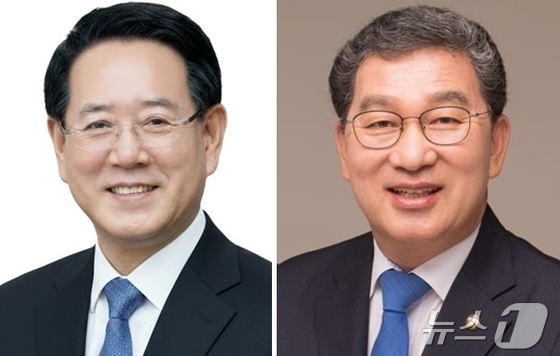
On March 18, campaign teams for Democratic Party primary contenders Shin Jeong-hoon and Kim Young-rok — who are competing to become the party’s candidate for the June 3 local election for the integrated Jeonnam-Gwangju special mayor — exchanged sharp attacks.
Ye Gyun-soo, a spokesman for Shin’s campaign, said in a morning statement that Governor Kim Young-rok lacks the qualifications to serve as the integrated mayor because he has failed to demonstrate a record of achievement.
Ye called the roughly 500 trillion KRW (approximately $375 billion) semiconductor investment plan a baseless fantasy. He said Kim has delivered single-digit success in attracting investment over eight years, yet is now making pledges worth hundreds of trillions of KRW ahead of the election. Promising such large-scale investments without concrete results or evidence, Ye argued, amounts to deliberate deception.
Ye also accused Kim of overseeing a population decline in Jeonnam — from 1,883,000 in 2018 to an estimated 1,780,000 by the end of 2025, a drop of more than 100,000 — and of forcibly splitting the Gwangju-Jeonnam Development Institute, an organization symbolic of the Jeonnam-Gwangju integration. Ye said Kim owns a home in Seoul but insists on living in the official residence, which he called disrespectful to local residents.
“Kim’s eight years in office can be summed up in one word: incompetence,” Ye said, urging Kim to reflect on his record and focus on finishing his provincial administration rather than making grand promises about running again for the special mayor post.
In the afternoon, Kim issued a rebuttal, calling Ye’s claims dangerous distortions of the facts.
Kim said he will secure the semiconductor investment in the 500 trillion KRW range (approximately $375 billion) as a central pledge of the Jeonnam-Gwangju special mayor campaign. He said domestic and international firms, including OpenAI and Samsung SDS, have already shown interest and are considering investment. Kim added that the Yongin semiconductor complex is saturated, and that Jeonnam and Gwangju — with abundant electricity and water resources — are natural alternatives for future investment.
On the population issue, Kim asked what concrete measures Shin, who chairs the National Assembly’s Administration and Security Committee, has proposed. He noted that the separation of the Gwangju-Jeonnam Development Institute was initiated under former Governor Lee Nak-yeon, and emphasized that although he owns a home in Seoul, he has never neglected provincial governance.
Kim said the immediate priority is to demonstrate good governance to citizens as the country prepares to launch the nation’s first integrated Jeonnam-Gwangju special city. He added that while he understands Shin’s zeal in criticizing him, he is concerned some of those attacks could risk violating election law.










Most Commented