
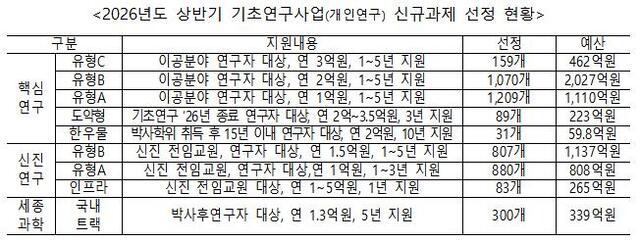
The Ministry of Science and ICT announced on the 12th that it has selected and will fund a total of 4,628 basic research projects for the first half of this year.
The new awards cover individual basic research programs—Core Research, Early-Career Research, and the Sejong Science Fellowship (domestic track)—with 2,558 Core Research projects, 1,770 Early-Career projects, and 300 Sejong Science Fellowship projects chosen.
Since the start of the Lee Jae-myung administration, the ministry has increased the basic research budget and strengthened researcher-centered support. As a result, the number of selected basic research projects rose by 914 compared with last year.
The ministry specifically increased seed funding for early-career researchers to encourage the development and recruitment of STEM talent and to improve both the quantity and quality of research outputs.
Early-Career Research projects rose from 965 last year to 1,687 this year, a 75% increase. The domestic track of the Sejong Science Fellowship also increased from 200 projects last year to 300 this year.
The ministry is also promoting the creation of a long-term, stable research environment under the \”Basic Research Ecosystem Promotion Plan\” announced last December.
In the Early-Career Research field, the ministry extended the Seed Research program — previously a one-year grant of 100 million KRW (about $75,000) — to three years. For Core Research Type A, support was expanded from 70 million KRW (about $52,500) over three years to 100 million KRW (about $75,000) over five years, providing a foundation for longer-term research.
Many examples demonstrate that the researcher \”growth ladder\”—from the Sejong Science Fellowship (postdoctoral support) through Early-Career Research to Core Research (formerly mid-career)—is functioning in practice.
As the government worked to improve conditions for foreign researchers, the number of international researchers rose sharply. In the first half of the year, 114 foreign researchers from 24 countries were selected, 78 more than the 36 chosen in the previous year.
Regional projects accounted for 2,159 of the selected projects in the first half, representing 47% of the total. That is 618 more than the 1,541 regional projects in the first half of last year. The more balanced increases across the country’s four major regions and five special regions point to strengthened regional basic research capacity.
The ministry plans to select about 2,000 additional basic research projects in the second half of the year to help more researchers secure stable research conditions.
Deputy Prime Minister and Minister of Science and ICT Bae Gyeong-hoon said, \”We will tightly link the basic research growth ladder—from Sejong to Early-Career to Core—and ensure that support for the remaining projects in the second half proceeds without disruption so that more researchers can focus on their work.\”
Hanbit Lee, hblee@viva100.com









Most Commented