
Translation result The seismic shift facing 20th-century urban planning
South Korea’s cities face persistent twin challenges: expanding housing supply and using limited urban space more efficiently.
Rapid growth in single-person households, an accelerating shift toward a super-aged society, and the changing logic of living and working driven by digital transformation are reshaping household structures and lifestyles. Yet our urban planning system remains trapped in an outdated, 20th-century industrial model—rigid zoning.
Historically, planners managed cities with strict use-based rules—“this is residential, that is commercial.” In today’s fast-evolving urban environments, those inflexible, retroactive controls stifle dynamism and block efficient reconfiguration of space.
Downtowns, which need high-density, mixed-use development where housing and workplaces coexist, are held back by uniform use categories that suppress market creativity and waste spatial potential. We now need a fundamental paradigm shift in urban planning. To chart that path, policymakers should study the recent ULI analysis of Nashville’s urban growth.
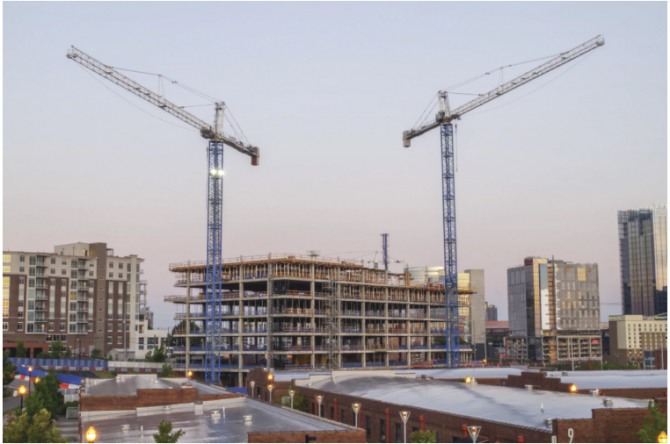
Nashville’s turnaround: the power of form-based zoning
Nashville reversed its housing shortfall in recent years by rethinking planning rules. The city moved from regulations focused on “use” to a system centered on “form.” The implementing tool was form-based code: rules that regulate a building’s physical form—height, street relationship, pedestrian-friendly façades, and fit within the urban fabric—rather than prescribing internal uses.
When a building meets exterior design and urban-form standards, its interior can respond to market demand—housing, offices, or mixed creative spaces—without needing a prior land-use designation.
That flexibility helped Nashville add roughly 10,000 units downtown and about 50,000 across the region since 2020, surpassing levels the city had projected for sustainable growth. Removing rigid use barriers allowed the market to find more efficient space solutions, which eased rent pressures and strengthened housing stability in a virtuous cycle.
 Remove permitting uncertainty: revive private supply
A second lesson from Nashville is the predictability and transparency of its permitting system. In Korea, housing projects must navigate multiple review stages and opaque administrative steps. Developers begin projects under uncertainty about completion timelines, which stretches project schedules and raises financing costs. Those risks feed higher sale prices and rents, amplifying the housing burden for households.
Nashville overturned conventional administrative practice by digitizing permitting and consolidating processes into a transparent, streamlined system. When developers can reliably forecast approval timelines, uncertainty falls—and private capital returns as the engine of supply. Reduced risk spurs competition among firms to design better spaces and deliver them efficiently, which improves housing outcomes citywide.
Why shift to form-based zoning?
Urban planning’s purpose is to create environments where citizens can thrive. Current regulations, by fixing uses, reduce a city’s adaptive capacity. Form-based rules offer three core benefits.
First, market-adaptive reuse. Buildings can change interior functions after construction to reflect market conditions, reducing waste and enhancing downtown sustainability.
Second, coherent urban character. By requiring physical forms that harmonize with their surroundings regardless of use, cities preserve integrated, high-quality streetscapes rather than become functionally fragmented.
Third, unleashed market creativity. The public sector sets the big-picture form and design guidelines; the private sector fills in the functional details creatively, maximizing spatial efficiency.
Implications for Korean urban policy: from regulation to support
Applying Nashville’s lessons to Korea requires a fundamental shift in administrative thinking. The public sector should move from “manager” to “platform provider.”
First, redefine public and private roles. The public should set form and design guidelines and provide incentives for private actors to flexibly supply functions—work, housing, and recreation—within those frameworks. Policymakers must stop viewing developers solely as regulated entities and start treating them as strategic partners in enhancing urban competitiveness.
Second, fully digitize the integrated permitting system. Simplify complex review processes into a digital, consolidated approval workflow so developers can predict timelines and quantify risks. Only then will private creative capital commit to urban regeneration.
Third, reform legal instruments to enable flexible use of space. Within existing planning law, expand special zones that relax rigid use categories. Pilot form-based zoning in high-transit downtown areas and on underused public land to measure impacts and scale successful approaches.
A macro proposal for sustainable cities
Housing policy is more than physical supply; it determines a city’s long-term sustainability. We should shift the question from “How do we control through regulation?” to “How do we make rules transparent to mobilize private vitality?”
Future cities must be flexible. As demographics change and industries digitize, urban space must adapt. The current housing crunch reflects not only a shortage of units but a structural rigidity in our systems. Form-based zoning is a powerful tool to dismantle that rigidity.
In particular, meeting demand for small units for single-person households and expanding shared-housing models is difficult under rigid use-based rules. A form-based framework lets the same physical footprint evolve into better housing solutions as needs change. That is the future we should pursue.
Conclusion: loosen the shackles of use, embrace form and flexibility
Sustainable urban growth does not come from artificial supply controls but from predictable rules that let the private sector build housing quickly and efficiently. Nashville’s experiment is more than a foreign example: it provides a clear roadmap for addressing our housing shortage. What we need is not an older, blunt regulatory blade but a new institutional blueprint to design the city’s future.
The city we leave to future generations should be an evolving, responsive ecosystem—not a rigid container. That is the central lesson from Nashville and the goal Korean urban policy should pursue. Now is the time to break the 20th-century chains of use-based thinking and move toward a 21st-century city defined by form and flexibility. Our cities have the potential; realizing it depends on administrative will and a change in mindset.
This transformation will not happen overnight. But the first step must begin now. Managing physical order while letting the market determine functions—what I call “strategic flexibility”—is the key to restoring urban vitality and addressing the housing problem at its roots. We must shift the axis of urban planning: move beyond fixed notions of use and prepare to shape better lives within a more flexible form. Only then can Korea’s cities sustain growth amid rapid change, from rising single-person households to an aging population.










Most Commented