
Translation result.
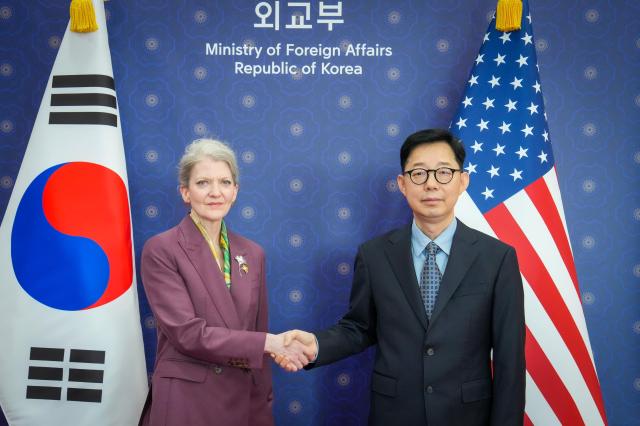
U.S. officials agreed on the need for rapid results, and follow-up discussions that had stalled for months after the leaders’ October agreement last year are now back on track. Still, U.S. domestic politics and trade issues are likely to be major variables in the negotiations ahead.
On the 3rd, delegations from South Korea and the U.S. met for a second day at the foreign ministry building to discuss implementation of security cooperation, including construction of nuclear-powered submarines and securing rights to enrich and reprocess uranium.
The foreign ministry said the two sides agreed to establish a year-round performance review mechanism to deliver concrete outcomes quickly and to accelerate future talks. They discussed a preliminary timeline and broad milestones, and plan to hold a second meeting in Washington, D.C., possibly as early as next month.
The talks focused primarily on amending the existing U.S.-Korea nuclear cooperation agreement to grant South Korea enrichment and reprocessing rights. Under current arrangements, South Korea may enrich and reprocess up to—but below—20% only with written U.S. consent (effectively a license). By contrast, Japan requires U.S. consent only when enrichment exceeds 20%.
Seoul aims to secure broader authority while avoiding the full-scale renegotiation that took five years in 2010–2015. Officials are considering faster alternatives such as partial amendments or side agreements. They are also making the case that a pan‑Pacific nuclear fuel supply chain would bolster U.S. energy security.
On the nuclear‑submarine front, officials discussed the key cooperation needed to secure fuel. The government plans to develop the reactor and propulsion systems domestically and rely on the U.S. to supply only low‑enriched uranium fuel. Receiving military‑grade fuel for combat submarines will require a separate agreement beyond the current civilian nuclear pact.
Experts point to the 2024 AUKUS agreement among Australia (a non‑nuclear‑weapon state), the U.S., and the U.K. as a relevant reference case.
Time is Seoul’s most pressing concern. Officials feel urgency to advance the deal to a point where President Donald Trump cannot reverse it while he remains in power. Because the initiative originated from President Trump’s personal decision—departing from the U.S.’s traditional nonproliferation posture—the effort could lose momentum if Republicans lose control of Congress in the November midterms or if his term ends.
Trade disputes and nonproliferation worries are likely to become flashpoints in future talks. U.S. frustration over the pace of South Korean investment in the United States and concerns stemming from the Coupang data breach contributed to delays in this month’s security consultations.
Given U.S. worries that South Korea could pursue nuclear weapons, Washington is also expected to press for stringent controls on nuclear materials and robust information‑security measures, similar to those imposed under AUKUS.








Most Commented