
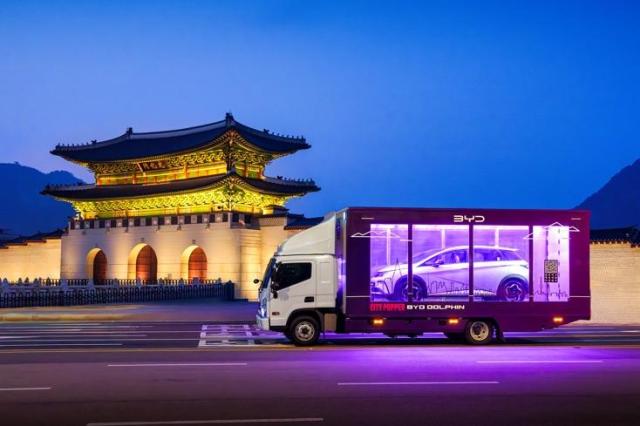
![[사진=BYD코리아]](https://contents-cdn.viewus.co.kr/image-7fa7ec20-b222-41f0-adf2-44f185499290.jpeg)
Electric automaker BYD is a central figure in any discussion of the “China Dream.” Last year the company sold about 4.55 million vehicles worldwide, capturing roughly 20% of the global electric-vehicle market and becoming the industry’s top seller. What was a near‑nonexistent auto industry in China through the late 1990s has, in about 30 years, become the dominant force in EVs, accounting for more than 70% of the global market. Dozens of EV brands appear each year in China and more than 80% quickly vanish; BYD survived that churn and, in 26 years, rose to the top. Here’s the story of the company that tells Chinese youth to “Build Your Dreams.”
◆ February market share 6.4% — settles into the top five within a year
On March 13, the Korea Imported Automobile Association reported BYD sold 957 units in Korea in February, placing the brand seventh for the month behind Tesla (7,868 units), BMW (6,313), Mercedes‑Benz (5,322), Lexus (1,113), Volvo (1,095) and Audi (991). BYD’s cumulative January–February sales totaled 1,347 units, representing a 6.43% share of the Korean market and securing a spot among the top five brands by early‑year volume — a notable achievement for a brand that only launched in Korea last March.
BYD’s headline model is the compact electric SUV Atto 3, credited with ushering in a “20 million KRW (about $15,000) EV” price tier; it has sold 753 units this year. Other steady sellers include the small hatchback Dolphin (81 units), the mid‑size SUV Sea Lion 7 (1,277 units) and the Seal (193 units). BYD’s strength lies in solid performance at accessible prices: model prices range roughly from 25,000,000 to 46,900,000 KRW before subsidies (about $18,750–$35,175), lowering the barrier to EV ownership.
An electric vehicle’s fate hinges on its battery technology. BYD equips its cars with its proprietary lithium‑iron‑phosphate (LFP) Blade Battery to enhance safety and charging convenience. The company recently introduced a second‑generation Blade Battery and a FLASH charging system to tackle two persistent EV pain points: charging speed and poor low‑temperature performance. After six years of development, the second‑generation Blade Battery shortens charging times dramatically, reaching 70% state‑of‑charge from 10% in about five minutes and 97% in nine minutes — roughly comparable to refueling a gasoline car. A DENZA Z9GT fitted with this battery is claimed to have an NEDC‑style range of 1,036 km (about 644 miles).
BYD expects to surpass 10,000 cumulative sales in Korea within the first quarter. Reaching 10,000 units within a year would be the fastest pace for an imported brand in Korea. For context, BMW Korea took seven years to hit that milestone after entering the market in 1995, Mercedes‑Benz took three years, and Tesla took four.
◆ Learned design by reassembling Tesla — from auto backwater to world No. 1
BYD stands for Build Your Dreams, a slogan that also reflects the entrepreneurial outlook of founder Wang Chuanfu. Wang predicted that the future of automobiles would be defined not by engines but by batteries, and he believed control of battery technology would make a company a key player in the EV era.
A former nickel‑cadmium battery researcher at a government lab, Wang launched his company in Shenzhen in 1995 with 2.5 million yuan (about $362,525; 540,000,000 KRW, about $405,000). He applied a rapid “copy, analyze, improve” approach — buying premium products, disassembling them and learning from their design — to accelerate development. A widely told anecdote says that when Elon Musk brought the first 10 Tesla vehicles into China, Wang bought one, took it apart and reassembled it to study the design. He continued to buy and break down competitors’ cars to build technical know‑how, a practice that helped BYD climb to the top of the global EV industry.
BYD’s competitive edge comes from vertical integration: it manufactures batteries, semiconductors and vehicles in‑house. That structure enabled the company to control costs and ramp production quickly. Investor Charlie Munger has praised Wang, likening him to a mix of Thomas Edison’s inventiveness and Jack Welch’s management skill. BYD now ranks among the top automakers globally by market capitalization, behind Tesla and Toyota.
The company’s “Build Your Dreams” push continues. BYD expanded beyond battery‑electric vehicles (BEVs) to offer plug‑in hybrid (PHEV) variants and has launched premium marques such as DENZA, Wang Yang and Fang Cheng Bao, aiming for aspirational models. The Wang Yang line, launched in 2023 and billed as a “Chinese Rolls‑Royce,” showcases advanced tech in models like the U8 luxury off‑road SUV and the U9 electric supercar. The U8 reportedly offers roughly 30 minutes of buoyant amphibious capability and four independent motors that enable tank‑turn maneuvers; the U9 draws attention for dramatic choreography-like movements that make the car appear to dance and hop in place.
BYD has evolved beyond a conventional automaker into a global technology company emblematic of the EV era. Wang’s rise from a near‑nonexistent auto industry to building a market leader has become part of the China‑Dream narrative and a source of inspiration for young Chinese entrepreneurs.
Still, BYD faces persistent controversies over design similarities and battery‑patent disputes. Early BYD models drew comparisons to flagship models from Toyota and Mercedes‑Benz, prompting complaints from those companies. In one interview, Tesla’s CEO quipped that he had “never seen their cars” when asked whether BYD was a competitor.
An industry source said BYD developed its success formula by repeatedly copying, modifying and then independently refining competitors’ products. The source added that to fully realize its “Build Your Dreams” brand promise, BYD now needs to deliver a distinct, original success story rather than rely on iterations of others’ designs.




Most Commented